



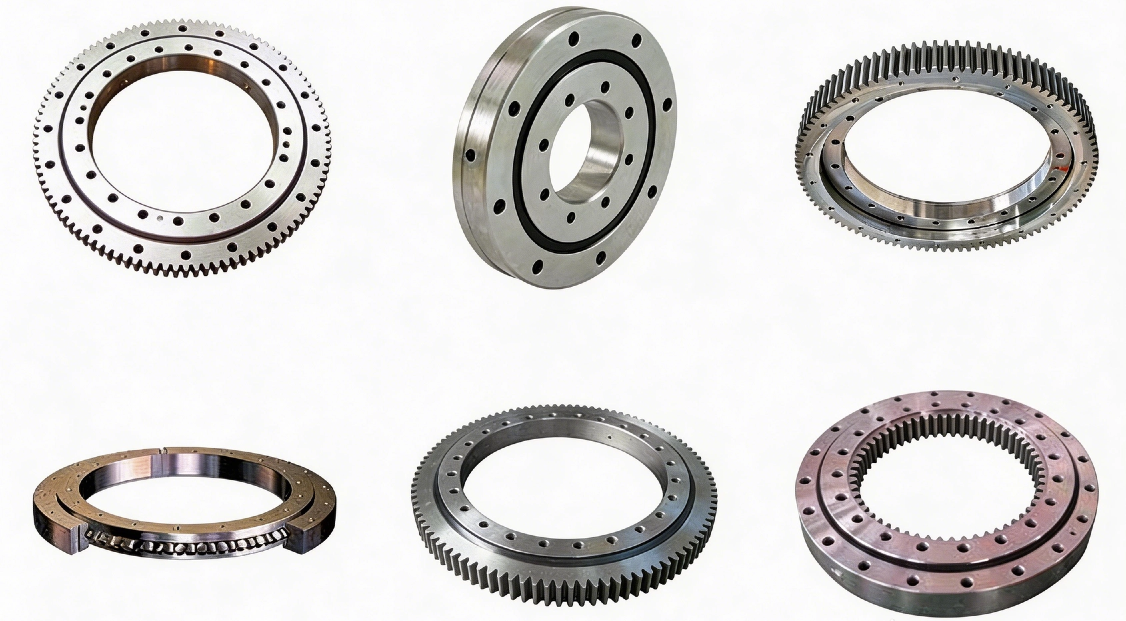
A Full Understanding of Slewing Bearings
In the sophisticated architecture of modern machinery, the ability to manage high-capacity, multi-directional loads while facilitating precise, controlled rotation is often the difference between operational success and catastrophic failure. At the core of this capability is the slewing bearing. Far from a simple component, these precision-engineered devices are complete rotational systems, functioning as the critical interface between a machine's fixed and moving structures. This comprehensive guide delves into the technical depths of slewing bearings, examining their engineering principles, material science, design complexities, and their pivotal role across demanding industrial applications.
What Is A Slewing Bearing?
A slewing bearing, also interchangeably known as a slewing ring or turntable bearing, is a large-scale, specialized rolling-element bearing designed to accommodate slow to moderate rotational speeds and oscillating movements. Its defining characteristic is its capacity to simultaneously support combined loads: high axial forces (parallel to the shaft), significant radial forces (perpendicular to the shaft), and substantial tilting moment loads (the overturning force that tries to tip the structure over). This integrated load management is achieved through its unique, large-diameter ring-in-ring construction.
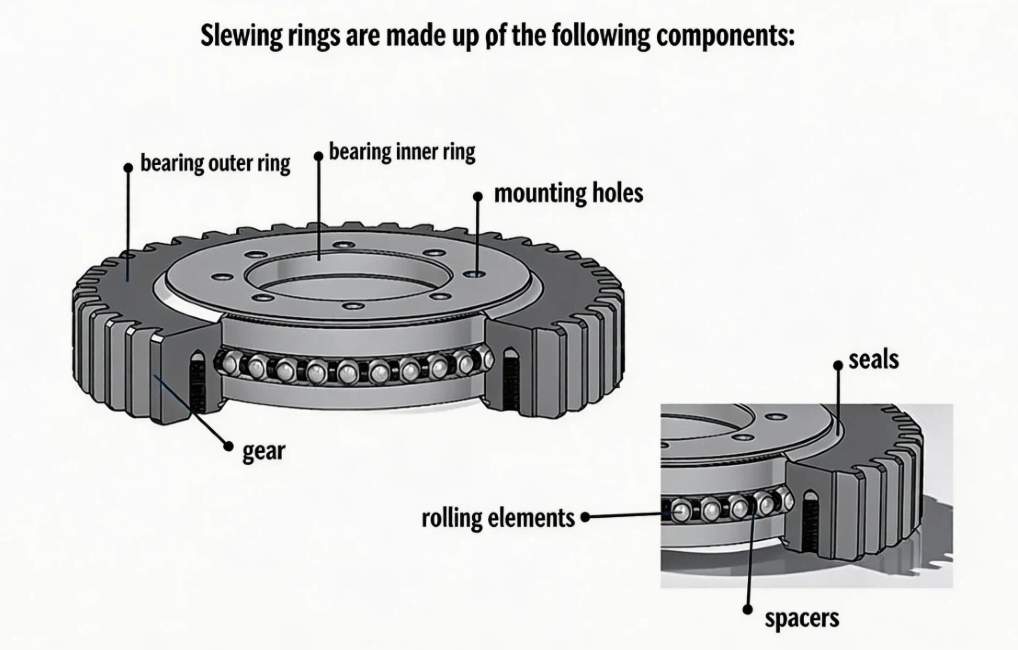
The fundamental architecture consists of four primary elements: an inner ring, an outer ring, an array of rolling elements (precision balls or rollers), and a spacing mechanism (either a cage or isolating spacers) to maintain proper separation and prevent friction between the rolling elements. Integral sealing systems are standard to retain lubricant and exclude environmental contaminants. A key differentiator for many applications is the integration of gear teeth—either on the inner or outer ring's circumference—transforming the slewing bearing into a gear-driven component. When mated with a driving pinion, this integrated assembly is precisely termed a slew drive, enabling controlled, high-torque rotation.
Industrial Slewing Bearing Types
The selection of a slewing bearing type is a critical engineering decision, dictated by the specific load spectrum, required precision, and operational environment. Our product line is engineered to meet these diverse demands:
1. Single Row Slewing Ring Ball Bearings: This is the most prevalent design, typically engineered as a four-point contact bearing. The raceways are ground with a Gothic arch profile, creating four distinct contact points with each ball. This geometry allows a single row of balls to effectively handle axial loads from both directions, radial loads, and moderate moment loads. It offers a cost-effective solution for a wide range of applications where loads are balanced and rigidity requirements are standard.
2. Flanged Ball Slewing Bearings: A practical variant of the single-row design, this slewing bearing incorporates an integral flange on either the inner or outer ring. This design innovation serves to simplify the mounting structure of the host equipment. By eliminating the need for a separate, precision-machined mounting flange, it reduces overall system complexity, weight, and assembly time, making it ideal for compact designs.
3. Crossed Roller Slewing Bearings: For applications demanding high rotational precision and exceptional rigidity under all load conditions, the crossed roller design is the preferred choice. Instead of balls, it employs cylindrical rollers arranged in a 90-degree alternating pattern within a single raceway. This configuration provides line contact rather than point contact, resulting in significantly higher load capacity and minimal elastic deformation (high stiffness). It is the standard for precision robotics, medical imaging systems, and machine tool rotary tables.
4. Double Row Ball Slewing Ring Bearings: To address applications with higher axial and moment loads than a single-row slewing bearing can efficiently manage, the double-row design separates the load paths. One row of balls is primarily oriented to handle axial loads in one direction and the associated moment, while the second row handles the opposite axial load and moment. This separation reduces internal friction and wear under heavy, complex loading, providing a longer service life in demanding applications like large excavators and port cranes.
5. Three-row Roller Slewing Bearings: Representing the pinnacle of load capacity and rigidity, this slewing bearing type utilizes three independent rows of rollers. Two axial rows of rollers (one for each direction) are positioned on separate, parallel raceways to handle immense thrust and moment loads. A third, radial row of rollers handles all radial forces. This complete separation of load paths into dedicated roller sets allows for optimized geometry, achieving the highest possible performance for the most extreme applications, such as heavy-lift offshore cranes, large tunnel boring machines, and giant radar antennas.
The Design Features of Slewing Bearings
The performance and longevity of a slewing bearing are direct results of its detailed design features. The raceway geometry is paramount; its curvature and surface finish (typically super-finished) directly influence contact stresses, friction, and lubricant film formation. The rolling element complement—their size, number, and material—determines the fundamental load-carrying capacity. The spacing mechanism is more than a simple separator: a full-complement design (using spacers) maximizes load capacity but increases friction, while a caged design reduces friction and allows for higher speeds but slightly lowers capacity. Finally, the integral sealing system is a critical design element, often featuring multiple lips and specialized materials to provide a robust barrier against ingress of water, dust, and chemicals, while retaining the critical grease lubricant.
How Does a Slewing Bearing Work?
The operational principle of a slewing bearing is based on precision kinematics and tribology. Understanding this mechanism involves looking at the interaction of its key components under different load conditions.
1. Facilitating Rotational Motion
As the inner ring rotates relative to the outer (or vice-versa), the rolling elements (balls or rollers) are guided along the hardened raceways. The rolling motion of these elements dramatically reduces rotational friction compared to a plain bearing. Under an applied load, the rolling elements elastically deform at the contact points with the raceways, creating a small contact patch (known as Hertzian contact) that distributes the force efficiently.
2. Managing Multi-Directional Loads
The true engineering marvel of a slewing bearing is its ability to handle complex, combined loads simultaneously:
Axial and Radial Forces: When axial or radial forces are applied during rotation, the rolling elements roll along their designated raceways. This action effectively disperses the force across many elements, significantly reducing overall wear and tear on the bearing.
Tilting Moments: If a strong tipping moment (overturning force) is applied, the wide cross-section and the physical separation of the load paths within the slewing bearing's rings create a high restoring moment. The bearing's inherent structural design actively prevents any change in the relative position of the inner and outer rings, allowing it to withstand these powerful tilting forces.
3. Integration with a Drive System
When a slewing bearing is configured with integral gear teeth on either the inner or outer ring, it becomes part of a complete drive system. This gear meshes with a pinion gear connected to a motor or other prime mover. Through the operation of this drive, the pinion rotates the gear on the slewing bearing, causing the inner and outer rings to turn relative to each other. This precisely controlled motion completes the equipment's required task, such as rotating a crane boom or positioning a solar panel array.
What Materials Are Used In Slewing Bearings?
Material science is foundational to slewing bearing performance. Professional and accurate design, combined with the correct and reasonable choice of bearing manufacturing materials, is essential to ensure that slewing bearings have high performance and high reliability.
1. Rolling Elements
The rolling elements of a slewing bearing are typically manufactured from high-carbon chromium bearing steel. Common grades include GCr15 or GCr15SiMn (similar to 52100), which are through-hardened to achieve maximum strength, hardness, and fatigue resistance necessary for continuous rolling contact.
2. Inner and Outer Rings
The inner and outer rings of a slewing bearing are commonly forged from surface-hardened steel to create a component with a tough core and a hard outer layer. Typical materials include 42CrMo or 50Mn. These alloys are often induction-hardened on the raceways to achieve a hard, wear-resistant surface (typically 55-60 HRC) while retaining a tough, ductile core to absorb shock loads. If the host machine or working environment has special requirements, the rings can also be made from stainless steels like 440C or 420C, or other grades of 45 steel.
3. Spacer and Cage Materials
As a professional supplier, our slewing bearings utilize different types of cages and spacers, such as isolation blocks, integral cages, and segmented cages, each suited for different working conditions.
Integral or segmented cages are typically made from materials like brass, carbon steel, cast aluminum, or nylon.
Spacer cages (isolation blocks) are commonly manufactured from polyamide resin, nylon, cast aluminum, or aluminum bronze. These materials are chosen to provide the right balance of strength, weight, and low friction against the rolling elements.
4. Seals
The sealing system is a critical component of any slewing bearing, protecting its internal parts from contaminants and retaining lubricant.
For most standard applications, slewing bearing seals are made from oil-resistant nitrile rubber (NBR) , which offers excellent abrasion resistance and durability.
For applications requiring higher minimum and maximum temperatures, or resistance to specific chemicals, we can utilize fluoroelastomer (FKM/Viton) seals or other specialized sealing materials to ensure the bearing's long-term integrity.
Considering Factors for Slewing Bearing Design
The correct specification or design of a slewing bearing is a complex systems engineering task, requiring a holistic evaluation of the entire application:
Load Magnitude and Direction (The Load Spectrum): This is the primary design input. Engineers must calculate not just the static loads, but the dynamic load spectrum, including peak loads, shock loads, and the number of operating cycles. The combined effect of axial load (Fa), radial load (Fr), and the resultant tilting moment (Mk) must be analyzed using specialized bearing calculation software to determine static load safety (fs) and dynamic life (L10h).
Accuracy and Stiffness Requirements: Applications like machine tool tables and robotic arms demand high rotational accuracy (runout) and system stiffness. This dictates the selection of precision-grade bearings (e.g., crossed roller) and may require preloading to eliminate internal clearance and enhance rigidity.
Operational Speed and Dynamics: Slewing bearings are designed for low-speed, high-torque applications. Speed influences lubrication selection and heat generation. The design must also consider the dynamic behavior, ensuring stability under varying speeds and loads.
Environmental and Thermal Conditions: Operating temperature range dictates material selection (for rings, spacers, and seals) and lubricant type (mineral vs. synthetic oil/grease). For extreme cold or heat, special heat-treated steels and high-performance lubricants are mandatory. Corrosive environments may necessitate stainless steel rings and special coatings.
Sealing Strategy: The sealing system must be matched to the environment. Heavy contamination requires robust, multiple-lip seals, possibly with metal excluders. High-pressure washdowns require seals with higher contact pressure and specialized materials.
Lubrication System Design: The choice between initial grease lubrication and a central re-lubrication system is critical. Re-lubrication channels must be designed into the bearing structure to ensure fresh grease reaches all critical raceways and gear teeth, purging old, contaminated lubricant.
Gear Integration and Drive Dynamics: For a slew drive application, the gear's module, number of teeth, material, and heat treatment (e.g., tooth flank hardening) must be designed to transmit the required torque with acceptable wear life and backlash. The interaction between the pinion and the ring gear is a complete tribological system.
What are the Advantages of Roller Slewing Bearings?
While ball bearings are effective for many applications, roller-based designs offer distinct mechanical advantages:
Superior Load Capacity and Rigidity: The line contact of a roller on a raceway distributes load over a much larger area than the point contact of a ball. This allows crossed and three-row roller slewing bearings to support significantly higher loads and exhibit much higher stiffness (resistance to deflection), which is crucial for precision under load.
Optimized Load Paths: In three-row roller designs, the complete separation of axial and radial load paths allows each set of rollers to be optimized for its specific function, resulting in a slewing bearing that can handle extreme, complex loads more efficiently than any combined-load design.
Enhanced Shock Load Resistance: The greater contact area makes roller slewing bearings inherently more resistant to damage from sudden, heavy shock loads, a common occurrence in mining and heavy construction equipment.
Slewing Bearing Application Industries
The unique functional attributes of slewing bearings make them indispensable in a vast array of critical industries:
Construction and Heavy Equipment: They are the pivotal joint in excavators, cranes (mobile, tower, crawler), aerial work platforms, and concrete pumps, enabling 360-degree operation while supporting immense digging and lifting forces.
Renewable Energy: In wind turbines, slewing bearings are used in the blade pitch system to control rotor speed and in the yaw system to orient the nacelle into the wind, operating continuously under dynamic and extreme weather loads.
Material Handling and Ports: Giant stackers, reclaimers, and ship-to-shore cranes rely on large-diameter slewing bearings to rotate and position their booms for efficient bulk material handling.
Robotics and Automation: Precision crossed roller slewing bearings are the joints in industrial robots, enabling high-speed, high-accuracy pick-and-place, assembly, and welding operations.
Defense and Aerospace: They are critical components in radar systems, satellite communication antennas, missile launchers, and tank turrets, providing the necessary precision and reliability in the most demanding conditions.
Medical Technology: Large-bore, precision slewing bearings enable the smooth, quiet, and accurate rotation of CT scanners, linear accelerators, and surgical C-arms.
LyraDrive: Get Slewing Bearing 3D Drawing for Your Application
For over 15 years, LyraDrive has stood as a pillar of engineering excellence in China, specializing in the design and manufacture of high-performance slewing bearings and integrated slew drives. We recognize that optimal machine performance begins with a perfectly matched rotational component.
Our comprehensive slewing bearing product portfolio is engineered to address the full spectrum of industrial challenges, providing the exact solution for your application's load, precision, and environmental demands. We manufacture:
Flanged Ball Slewing Bearings
Three-row Roller Slewing Bearings, and more.
At LyraDrive, we specialize in providing tailored slewing bearing solutions to meet your unique application requirements. By submitting your sample or drawing, our engineering team conducts a comprehensive 3D technical analysis and design review. Based on your specific needs, we then carry out a series of precision manufacturing and production processes, ensuring that the final product is delivered exactly to your expectations. With LyraDrive, you can count on customized results that combine innovation, quality, and reliability.
 WhatsApp
 sales@lyradrive.com
 +8613903880726