



What is a split slewing ring? It is a large-diameter slewing bearing built in two or more segments, so it can be installed where a one-piece ring cannot be lifted or slid into place. The segments are joined with bolts and aligned at the joints to form one continuous raceway.
That joint is where buyers get burned. If you place an RFQ without asking how the joint behaves under your overturning moment, you may find out on site, after the ring is already in service. This article answers the questions engineering teams should settle before choosing a supplier.
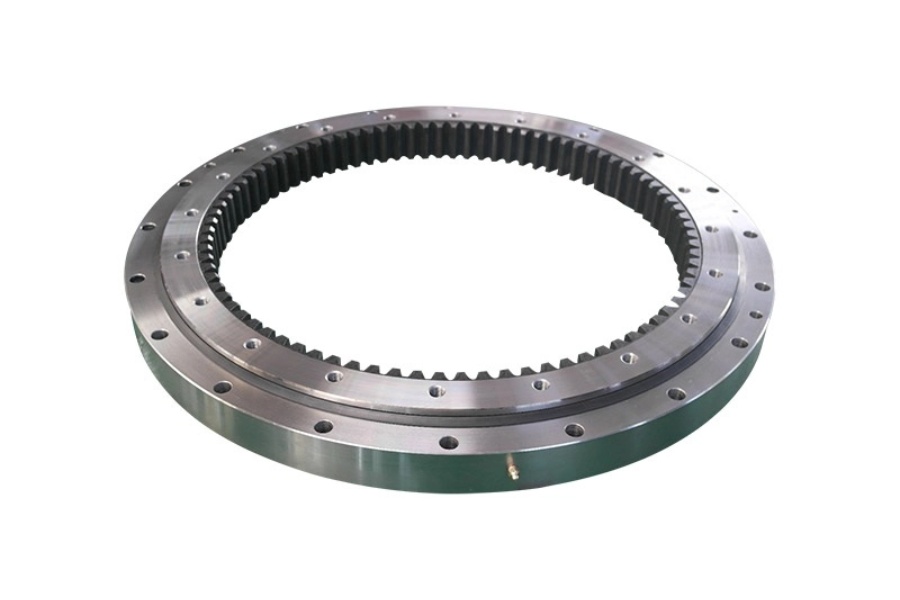
Do You Really Need a Segmented Ring?
Is a split design better than a one-piece bearing?
No. It is a workaround for access, not an upgrade. A one-piece slewing bearing has a continuous raceway and carries its own stiffness. Choose a segmented ring only when installation, transport, or field replacement makes a solid ring impractical.
When does a segmented ring make sense?
It fits retrofits where the shaft, column, or housing cannot be removed. It also fits sites with lifting or shipping limits, and very large diameters where a single ring is hard to handle.
It does not fit well when the application is compact and a one-piece slewing bearing can be installed normally. It also fits poorly when the mounting structure is thin or flexible, because the segmented ring depends on that structure for stiffness.
How Do Segment Joints, Bolt Stiffness, and Raceway Alignment Limit Performance Under High Overturning Moment?
Under a high overturning moment, one side of the ring is pulled apart while the opposite side is pressed together. A continuous ring spreads that load around its full circumference. A segmented ring has interruptions, so three things decide whether it holds up.
| Limiting factor | What happens under high moment | Typical consequence | What to ask the supplier |
|---|---|---|---|
| Segment joint | The raceway is interrupted. Load passes across a mechanical seam instead of continuous steel. | Local stress at the joint, uneven rolling element loading | How is the joint located and clamped? How is joint-zone raceway quality inspected? |
| Bolt stiffness and preload | Tension-side bolts see cyclic load. Low preload or a soft joint lets the seam open slightly. | Micro-gap, fretting, bolt loosening, raceway step | What preload is specified? Is it checked against your moment case? |
| Raceway alignment | Any step or angular offset at the joint is crossed by every rolling element on every revolution. | Noise, torque spikes, edge wear, early surface damage | What alignment is measured and reported at the joint after assembly? |
| Mounting structure stiffness | A flexible frame deforms the segmented ring more than it would a one-piece ring. | Joint opening, raceway distortion | What flatness and stiffness does the supplier assume for the mating surfaces? |
The practical limit is this: a segmented ring is more sensitive to joint quality and to the structure beneath it. High moment, shock loads, and frequent start-stop cycles amplify that sensitivity. Low-speed, light-duty, or well-supported applications are more forgiving.
We do not publish a universal moment limit for segmented rings, because it depends on ring size, raceway type, bolt grade, preload, and the supporting frame. Anyone quoting a single number without your load case is guessing.
Request Your Custom Slew Drive or Bearing Spec
Tell us your load, speed, and environment — receive a tailored 100–5000 mm slewing drive or slewing bearing proposal with 3D drawings within 24 hours.
What Evidence Should a Supplier Provide Before You Order?
What documents prove the joint is sound?
Ask for specific records, not general assurances. A good supplier can show how the segments were machined, assembled, and checked as a set. Use this checklist:
- Load-case review: your axial load, radial load, and overturning moment, including peak and shock cases, checked against the selected design.
- Bolt specification: grade, quantity, and preload method for the joint and mounting bolts.
- Joint alignment report: measured step or offset at each joint after assembly.
- Dimensional inspection: coordinate measurement records for the finished ring.
- Material and heat treatment records: including how the raceway hardening is handled near the joint.
- Mounting requirements: flatness and stiffness assumptions for your frame.
What can Luoyang Slewring Bearing Co., Ltd. confirm?
Our factory is ISO 9001:2015 certified, and factory audit reports are available on request. Every slewing bearing we build passes CMM three-coordinate inspection and dynamic load testing, and our failure rate runs below the 0.5% industry standard. You can read more about our process on the slew drive quality control page.
For a segmented design, we would still review the joint details against your drawing before quoting. That review is part of our 24-hour technical proposal process, and we do not promise a fixed result until we see your loads.
Which Common Mistakes Cause Joint Problems?
Most joint failures trace back to the buying stage, not the factory floor. These are the errors we see engineers warned about most often:
- Specifying only static capacity. A ring can pass a static check and still struggle with cyclic moment at the joint.
- Ignoring the mounting frame. A thin or uneven structure undermines a segmented ring faster than a solid one.
- Reusing bolt preload from a one-piece ring. Joint bolts may need a different preload strategy.
- Skipping post-assembly checks. Alignment should be measured after the segments are joined, not only on individual pieces.
- Mixing segments between sets. Segments are machined and matched as a set. Swapping them can introduce a raceway step.
- Treating the joint as maintenance-free. Bolt tightness and joint condition need scheduled checks, especially in the first operating period.
How Can You Validate a Segmented Design Step by Step?
- Write down the full load case: axial, radial, overturning moment, speed, and shock events.
- Confirm whether a one-piece ring can be installed. If yes, compare it first.
- Share your mating structure drawing, including flatness and stiffness limits.
- Ask for the joint design, bolt specification, and preload method in writing.
- Request the alignment and dimensional inspection records for the delivered set.
- Agree on first-period inspection: bolt tightness, joint condition, and torque behavior.
Here is an illustrative scenario. A team retrofits a rotating platform where the center column cannot be removed. A solid ring will not pass over it, so a segmented ring is the only option. The team reviews moment peaks, confirms the frame is stiffened near the mounting circle, and asks for post-assembly alignment data. This is the type of case where the segmented ring is justified and the risks are manageable.
How Does Duty Cycle Change the Answer?
Heavy, repeated overturning loads call for more scrutiny. In those cases we often point buyers to a three-row roller slewing bearing or a heavy load slewing bearing in one-piece form, if the installation allows it.
Our case record shows the kind of duty we engineer for, though these are slew drive projects and not segmented ring references. A Houston, Texas machinery manufacturer ordered 100 units of SEA21-125-25HR(2) for slewing platforms. An Australian heavy equipment manufacturer uses HWE21-94-25HR.1 double worm slew drives in mining excavators. Both involve heavy, cyclic loads where load-path review matters from the start.
If your project needs a custom interface or a drive paired with the ring, our customized slew drive team can review it together with the bearing.
What Should You Send Us to Get a Reliable Quote?
Send your load case, ring diameter, mounting structure drawing, speed, and operating environment. Also tell us why a one-piece ring will not work, because that shapes the design.
On terms: standard products start at an MOQ of 1 set, and customized products start at 5 sets. We offer a 2-year extended quality warranty and free replacement for confirmed manufacturing defects, with a 48-hour technical response. Prototyping takes 3 days and the standard production cycle is 9 days, though a segmented or customized design may need its own schedule confirmed after drawing review.
If you are sourcing a split slewing ring for a specific duty cycle, send us the drawing and load data. Our engineers will tell you plainly whether the segmented route fits or whether another option is safer.
Request Your Custom Slew Drive or Bearing Spec
Tell us your load, speed, and environment — receive a tailored 100–5000 mm slewing drive or slewing bearing proposal with 3D drawings within 24 hours.
 WhatsApp

 +8613903880726