



What is slew drive lubrication? It is the controlled use of grease or oil to protect the bearing raceway, worm gear, gear teeth, and rolling elements inside a slew drive during rotation. The right lubricant must do more than reduce friction; it must remain in place, carry load, resist contamination, and flow at the equipment’s lowest expected temperature.
For design engineers and maintenance managers, the approval question is not simply “Which EP grease is good?” The better question is: which grease properties match the machine’s speed, load pattern, climate, sealing level, and exposure to water? A grease that performs well on a slow, dry turntable may be a poor choice for a washdown machine or an outdoor crane.
Start with the load path and motion pattern
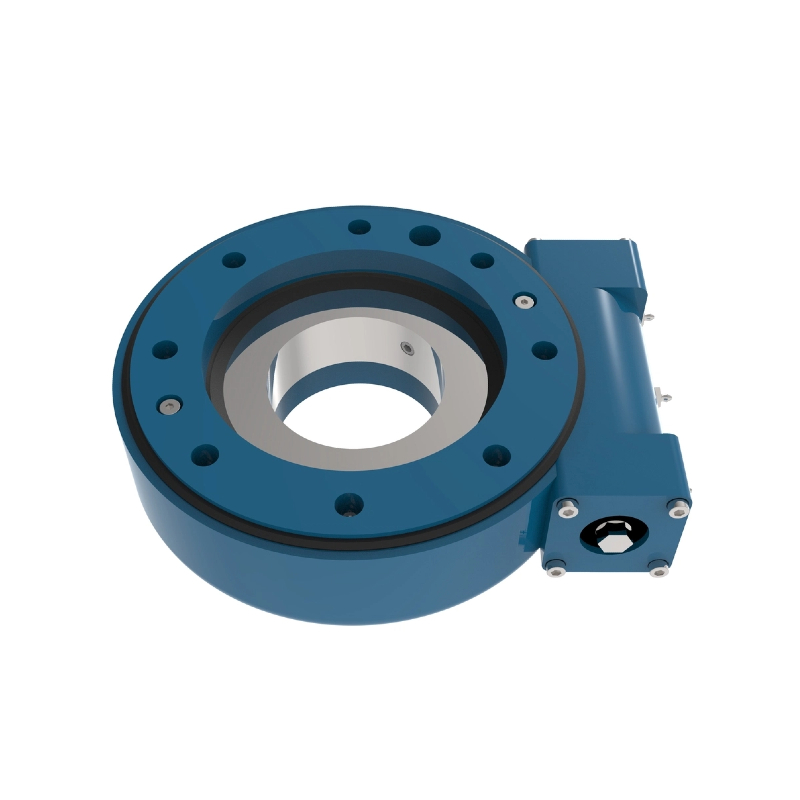
First identify where the lubricant must work. A typical Slew Drive combines a slewing bearing with a worm shaft and gear interface, so grease selection must account for both rolling contact and sliding contact. These surfaces create different lubrication demands, especially when the drive moves slowly under high torque.
Slow rotation does not mean easy lubrication. At low speed, there may be little opportunity for heat or motion to redistribute grease across the contact zone. A grease with suitable base oil viscosity and load-carrying additives can maintain a protective film, while an unsuitable grease may be pushed away from heavily loaded areas.
Use the following starting rule: select grease according to the highest-risk operating condition, not the average condition. If a platform rotates lightly for most of the day but occasionally holds a heavy offset load, the intermittent high-load event should influence the approval decision. This approach does not replace a supplier’s technical data review, because actual contact stress, gear geometry, and sealing design can change the result.
Separate bearing needs from worm gear needs
The slewing bearing raceway needs grease that can stay on rolling contacts and protect against wear under oscillation or partial rotation. The worm gear interface also needs a lubricant film that can tolerate sliding action between the worm and gear teeth. One multipurpose grease may serve both areas, but that must be confirmed rather than assumed.
For a worm drive that repeatedly reverses direction, grease redistribution can be limited because the same tooth zones see repeated contact. In this situation, inspect the grease path, lubrication points, and whether the drive completes enough rotation to spread lubricant. A grease choice alone cannot correct poor relubrication access or an unfilled cavity.
For equipment with very light loads and frequent motion, extremely high base oil viscosity may create excess drag at low temperatures. For equipment with slow movement and high overturning load, a grease with insufficient film strength may wear quickly even if it feels smooth during no-load testing. The correct choice depends on duty, not on a single label such as “heavy-duty grease.”
Comparison: Grease Base Oil Viscosity, EP Additives, Water Resistance, and Low-Temperature Behavior by Duty
Four grease properties should be reviewed together: base oil viscosity, extreme-pressure additives, water resistance, and low-temperature behavior. They interact. For example, a high-viscosity base oil may suit slow, loaded contact, but the same grease can become difficult to pump or distribute in cold weather.
The table below maps each property to common equipment duties. It is a specification-review tool, not a universal product recommendation. Confirm the grease manufacturer’s technical data, compatibility statement, and operating temperature range before releasing a lubricant for production.
| Duty condition | Base oil viscosity | EP additive need | Water resistance need | Low-temperature behavior | Approval limit |
|---|---|---|---|---|---|
| Slow-speed, high-load slewing platform | Favor higher viscosity to support a thicker film under slow rolling and sliding contact. | Usually important because high tooth and raceway loading can squeeze grease from the contact area. | Needed only if the machine sees humidity, rain, or condensation. | Review if startup occurs in cold weather or unheated storage. | Do not select on viscosity alone; confirm grease can reach all lubrication points. |
| Outdoor crane or mobile equipment | Choose for load while avoiding excessive stiffness during cold starts. | Useful where worm tooth loading and intermittent shock are present. | High priority because rain, spray, and condensation can enter through damaged seals or service openings. | Must remain pumpable and mobile at the lowest site temperature. | Water resistance does not compensate for a torn seal or blocked grease fitting. |
| Washdown or wet-process equipment | Select enough viscosity for load, then verify the thickener system resists washout. | Apply when load and sliding contact require it. | Primary requirement; grease must resist water removal and corrosion risk. | Relevant when washdown equipment is installed outdoors or in cold rooms. | Check chemical exposure separately; water resistance does not prove cleaner compatibility. |
| Cold-climate positioning equipment | Balance film strength with flow at startup temperature. | Use when load demands it, not as a substitute for suitable cold-flow properties. | Match outdoor moisture exposure. | Primary requirement; verify torque rise, pumpability, and grease mobility in cold conditions. | A grease that flows in a laboratory test may still be unsuitable for long external lines. |
What base oil viscosity changes in practice
Base oil viscosity is the grease property most closely tied to lubricant film thickness. In slow, heavily loaded drives, a higher-viscosity base oil often helps maintain separation between loaded surfaces. The trade-off is higher drag and reduced flow, especially during cold starts or when grease must travel through long lubrication lines.
Do not confuse grease consistency with base oil viscosity. A grease can appear firm or soft because of its thickener system, yet its base oil may still be unsuitable for the actual contact load. Ask for both the grease consistency classification and the base oil viscosity data when comparing candidates.
What EP additives do and do not solve
EP additives are intended to support protection when contact pressure rises and the lubricant film is stressed. They are often relevant to slow, loaded worm interfaces and heavily loaded raceways. Their presence does not mean the grease will resist water, remain mobile in winter, or be compatible with existing grease.
Molybdenum-containing grease deserves a separate review rather than an automatic approval or rejection. Solid lubricants can be useful in some loaded sliding contacts, but their suitability depends on the drive design, the lubricant supplier’s recommendation, and the equipment maker’s requirements. Do not approve molybdenum grease merely because it is marketed for heavy equipment, and do not assume it is required for every worm gear application.
Build a grease approval specification instead of naming a grease only
A lubricant approval should state the duty conditions and required grease properties. Writing only a trade name into a maintenance manual makes later sourcing difficult and can lead to substitutions that look similar but behave differently. A property-based specification gives purchasing teams and maintenance staff a defensible basis for comparing alternatives.
For new equipment, include the drive model, lubrication point, expected load pattern, rotational behavior, exposure conditions, and service method. For operating equipment, also record the current grease, relubrication history, seal condition, and observed symptoms. This separates a lubricant issue from a mechanical issue such as incorrect mounting, contamination, or bearing damage.
- Define the motion: Record whether the unit rotates continuously, oscillates over a short arc, indexes, or remains parked under load.
- Identify the governing load: Use the highest expected torque, overturning moment, shock event, or parked-load condition.
- Document the environment: Note rain, salt exposure, dust, washdown, humidity, process chemicals, and the lowest startup temperature.
- Review grease data: Compare base oil viscosity, EP chemistry, water resistance, corrosion protection, consistency, and low-temperature performance.
- Confirm compatibility: Obtain written guidance before mixing the new grease with the grease already in the drive.
- Validate in service: Monitor grease appearance, leakage, operating torque, noise, temperature trend, and seal condition after implementation.
Luoyang Slewring Bearing Co., Ltd. can support the mechanical side of this review when a lubrication decision is tied to drive selection. Our engineering team can provide a technical proposal within 24 hours, and customized products have a minimum order quantity of 5 sets. Grease approval still requires the final lubricant supplier’s data for the intended duty and environment.
For applications that need nonstandard mounting, torque, sealing, or operating conditions, a Customized Slew Drive review should include the lubrication method from the first design stage. This is particularly useful when access is limited after installation or when the machine will operate outdoors for long periods. It does not remove the need for a scheduled inspection plan.
Request Your Custom Slew Drive or Bearing Spec
Tell us your load, speed, and environment — receive a tailored 100–5000 mm slewing drive or slewing bearing proposal with 3D drawings within 24 hours.
Prevent common grease-selection mistakes before they become maintenance problems
Many lubrication failures begin with a reasonable-sounding shortcut. The problem is not always the grease itself; it is often an incomplete reading of the operating duty. The following checks address the misunderstandings most likely to change an approval decision.
- Mistake: Selecting the highest-viscosity grease for every loaded drive. Higher viscosity can improve film strength in slow, loaded contact, but it can also raise drag and hinder grease flow in cold conditions. Use it for slow, heavily loaded duty only after checking startup temperature and lubrication path.
- Mistake: Treating EP additives as a complete specification. EP protection addresses one part of the load problem. It does not establish water resistance, corrosion protection, seal compatibility, or low-temperature pumpability.
- Mistake: Mixing greases without a compatibility review. Different thickener systems and additive packages may behave poorly when mixed. When compatibility is not confirmed, remove old grease as practical and follow the lubricant supplier’s changeover guidance.
- Mistake: Blaming grease for water entry. Water-resistant grease can provide added protection, but damaged seals and open service points still allow contamination. Inspect seals, plugs, fittings, and housings before changing lubricant.
- Mistake: Ignoring parked loads. A drive may move only occasionally but hold a high static load for long periods. Review this duty because grease can be displaced from a repeated contact zone.
- Mistake: Approving grease from appearance alone. Color and general consistency are not enough. Require a technical data sheet and compare properties under the stated test conditions.
Inspection data should support the maintenance decision. Look for hardened grease at fittings, water-contaminated grease, metallic particles, abnormal leakage, changed drive torque, or unusual noise during rotation. These signs do not identify one root cause by themselves, but they tell the team whether to inspect lubrication, sealing, preload, mounting, and gear condition together.

Apply the duty method to outdoor, marine, and solar equipment
Outdoor equipment usually needs a balanced grease specification because load, water exposure, and temperature can vary in the same installation. An outdoor crane can see high loading during lifting, rain during idle periods, and cold starts after overnight shutdown. The approval should therefore address EP performance, water resistance, and cold behavior together rather than allowing one property to dominate.
Marine equipment adds a stronger contamination concern because moisture and corrosive exposure can affect external components and service practices. In a real application, UK Ocean Marine Systems ordered 20 WEA17-104-25H-R-REV.D units for shipboard crane systems. That case supports the relevance of matching drive protection and maintenance planning to marine service, but it does not establish one grease formula for all marine cranes.
Solar tracker duty is different. The drive often moves slowly through repeated positioning cycles, and outdoor temperature changes can be significant. Luoyang Slewring Bearing Co., Ltd. supplied SP-I 0229 spur gear slew drives for single-axis solar projects in Brazil, Argentina, and Chile, where the reported project result was energy yield improvement of up to 40%. That result should not be attributed to grease alone; tracker layout, controls, site conditions, and the complete drive system also affect energy production.
For solar equipment, confirm whether the grease must support long idle periods, daytime heat, nighttime cold, dust, and occasional rain. For crane and platform equipment, give more weight to peak load, shock, and moisture entry risk. Where the application needs two worms for load distribution or positional requirements, review the lubrication arrangement for a Double Worm Slew Drive rather than assuming the single-worm service procedure applies.
Use quality checks to connect lubricant choice with drive reliability
Lubrication is only one part of drive reliability. A correctly specified grease cannot compensate for unsuitable bearing capacity, incorrect installation, poor gear contact, or uncontrolled manufacturing variation. The best maintenance plan combines lubricant selection with incoming inspection, mounting verification, and periodic condition checks.
Luoyang Slewring Bearing Co., Ltd. operates an ISO 9001:2015-certified facility with six production lines and an annual capacity of 100,000 sets. Every slewing bearing passes CMM three-coordinate inspection and dynamic load testing under our stated quality-control process, and confirmed manufacturing defects are covered by a 2-year extended quality warranty. These controls help establish the mechanical baseline, while the equipment owner must still maintain the lubricant according to actual site duty.
For high-load projects, request evidence that matches the component being sourced. A Slew Drive Quality Control review can help purchasing and engineering teams align drawings, inspection expectations, lubrication provisions, and service access before release. This is especially useful when the selected grease requires frequent relubrication or when the machine cannot be easily stopped for maintenance.
The practical approval standard is clear: choose grease properties that fit the slow-speed load, water exposure, and temperature range; verify compatibility before changeover; then monitor the installed system. That method gives maintenance managers a usable basis for grease selection without treating any single additive, viscosity value, or brand name as a universal answer.
Request Your Custom Slew Drive or Bearing Spec
Tell us your load, speed, and environment — receive a tailored 100–5000 mm slewing drive or slewing bearing proposal with 3D drawings within 24 hours.
 WhatsApp

 +8613903880726