



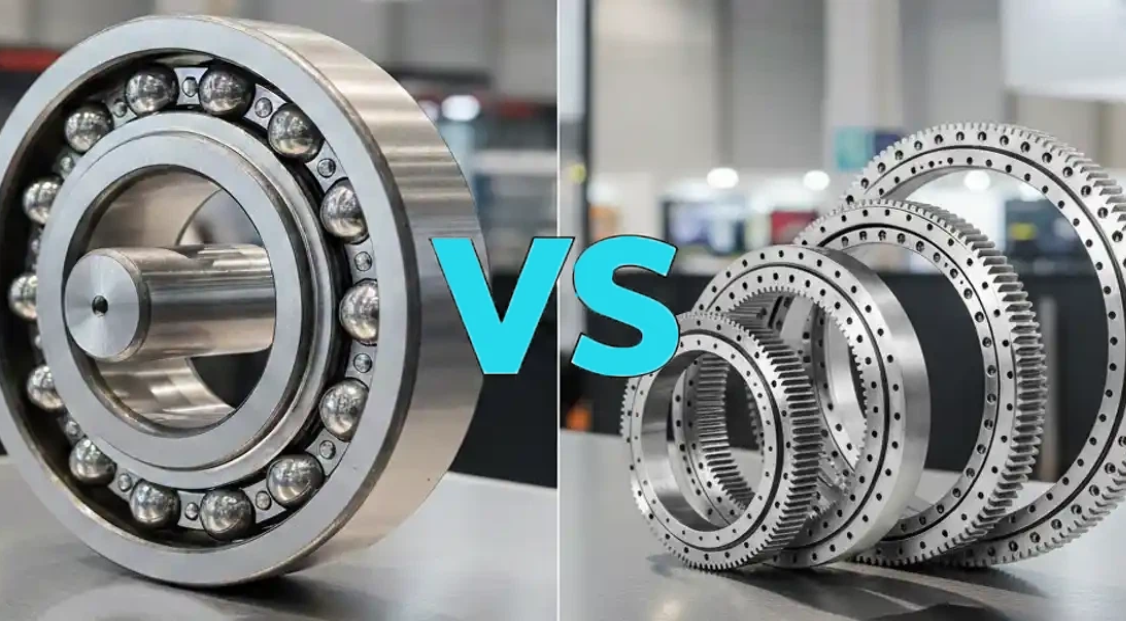
Ball Bearings vs. Slewing Bearings: Key Differences & Selection Guide
In the world of machinery and mechanical design, bearings are the unsung heroes that enable smooth, efficient rotation. When planning a new project, engineers often face a critical choice: which type of bearing is right for the job?
This guide will break down the distinct characteristics, core differences, and selection criteria for ball bearings and slewing bearings, helping you make the most informed and cost-effective decision for your application.
What is a Ball Bearing?
A ball bearing is a type of rolling-element bearing that uses spherical balls to maintain the separation between the moving parts of the bearing—known as the races. Its primary purpose is to reduce rotational friction and support both radial and axial loads.
How it works: The balls are housed in a cage and rotate between two concentric rings (the inner and outer race). Because the contact area between the ball and the raceway is very small (point contact), there is minimal friction, allowing for very high-speed rotation.
The Key Features and Functions of Ball Bearings
Ball bearings are the workhorses of the general machinery world. Their key features include:
Low Friction, High Speed: Their point-contact design generates very little heat, making them ideal for applications with high rotational speeds, often thousands of RPM.
Compact and Standardized: They are typically small, precise components that are manufactured to international standards, making them easily replaceable and widely available.
Primary Function: Their main job is to reduce friction in rotating parts, ensuring efficiency and longevity in items like electric motors, pumps, bicycle hubs, and fans.
What is a Slewing Bearing?
A slewing bearing, also commonly known as a slewing ring or turntable bearing, is a large, specialized rotational element. Unlike a simple ball bearing, it is designed to be a structural component of a machine. It can simultaneously handle heavy axial loads (thrust), radial loads, and the critical tilting moment load (the force that tries to tip something over).
How it works: Slewing bearings are characterized by their large diameter and robust construction. They typically consist of two concentric rings (one often with integrated gear teeth), rolling elements (balls or rollers), and mounting holes for direct bolting to a machine frame or platform.
The Key Features and Functions of Slewing Bearings
Slewing bearings are the giants of the bearing world, built for stability and power. Their key features include:
Multi-Directional Load Handling: They are uniquely capable of supporting complex load combinations, particularly the large tilting moments generated by cranes, excavators, and wind turbines.
Integrated Design: They often feature pre-drilled mounting holes and integrated internal or external gear teeth. This allows them to be driven directly by a slew drive (a compact drive unit consisting of a worm and a housing that meshes with the bearing's gear) to create a powerful rotation system.
Slow, Oscillating Movement: Slewing bearings are designed for(low speed), often less than 10 RPM, and intermittent rotation or oscillation. Their strength lies in stability under load, not high-speed rotation.
The 4 Core Differences: Ball Bearing vs. Slewing Bearing
To truly understand which component you need, let's compare them across four critical engineering dimensions:
1. Load Capacity and Type
This is the most significant difference. A ball bearing handles primarily radial loads well, but has limited capacity for heavy axial loads and cannot manage a significant tilting moment. A slewing bearing, in contrast, is specifically engineered to excel under combined loads. If your application involves a lever arm—like a crane boom or a robotic arm—a slewing bearing is essential to counteract the enormous tilting force.
2. Rotational Speed (RPM)
Ball bearings are built for speed. Their point contact minimizes friction and heat, enabling operation at thousands of RPM. Slewing bearings are built for torque and stability. Their larger contact surfaces (sometimes line contact with rollers) and size make them unsuitable for high speeds. They are optimized for slow, powerful rotations and precise positioning.
3. Structure and Integration
A ball bearing is a component that must be mounted onto a shaft and into a housing. A slewing bearing is a structural interface. It becomes a part of the machine frame. You bolt one ring to a stationary base and the other ring to the rotating structure (like the house of an excavator). The frequent integration of gear teeth directly onto the bearing ring simplifies the overall machine design.
4. Size and Scale
While ball bearings come in many sizes, from tiny instrument bearings to a few feet in diameter, they are generally compact. Slewing bearings start where standard ball bearings end. They are the giants, commonly ranging from 0.4 meters (16 inches) to over 10 meters (33 feet) in diameter.
Comparison Table: The Core Differences
| Feature | Standard Ball Bearing | Slewing Bearing |
|---|---|---|
| Primary Load Type | Radial | Axial, Radial & Tilting Moment |
| Contact Type | Point Contact | Point or Line Contact |
| Rotational Speed | High Speed (1,000+ RPM) | Low Speed / Oscillating (<10 RPM) |
| Mounting Method | On a shaft / In a housing | Bolted directly to flanges/surfaces |
| Gears | No | Often Integrated (Internal/External) |
| Typical Applications | Motors, Pumps, Conveyors | Excavators, Cranes, Radar, Wind Turbines |
Applications of Ball Bearings and Slewing Bearings
Understanding where each bearing type excels in real-world applications is essential for making the right selection. While both facilitate rotation, their vastly different capabilities lead them to very different corners of the machinery world. Below is a detailed look at the typical applications for each, highlighting why they are chosen for these specific roles.
Ball Bearing Applications: The Realm of Speed and Precision
Ball bearings are ubiquitous in modern machinery. Their compact size, ability to handle high speeds, and low friction make them the default choice for applications where efficiency and precision are paramount. You will typically find them in:
1. Automotive Components
Wheel Hubs: While larger vehicles may use tapered roller bearings, many passenger cars use ball bearings in their hubs to allow wheels to spin freely with minimal friction.
Alternators and Generators: These devices require high-speed rotation to generate electricity, making low-friction ball bearings ideal.
Transmissions and Differentials: They are used throughout gearboxes to support rotating shafts and reduce power loss.
2. Electric Motors and Pumps
Industrial Electric Motors: From small fan motors to large industrial drivers, ball bearings support the rotor, maintaining a precise air gap between the rotor and stator.
Water Pumps and Compressors: They handle the radial loads from the impeller or piston and ensure smooth, continuous operation.
3. Household Appliances and Power Tools
Washing Machines: They support the drum, allowing it to spin at high speeds during the wash and spin cycles.
Hard Disk Drives: Miniature, ultra-precision ball bearings are used to spin the platters at thousands of RPM with incredible smoothness.
Electric Drills and Grinders: They support the motor shaft and the output spindle, enabling high-speed rotation for cutting and drilling.
4. Aerospace and Precision Instruments
Aircraft Engines: Specialized high-temperature ball bearings are used in auxiliary systems and gearboxes.
Gyroscopes and Medical Devices: Precision instruments rely on the smooth, low-friction motion of miniature ball bearings for accuracy.
Slewing Bearing Applications: The Realm of Heavy Lifting and Positioning
Slewing bearings are the giants chosen for applications where the primary demands are strength, stability under massive loads, and the ability to handle complex forces. They are structural components themselves. Their typical applications include:
1. Construction and Material Handling
Excavators and Cranes: This is the most classic application. The slewing bearing connects the upper carriage (house) to the undercarriage (tracks), allowing the machine to rotate 360 degrees while digging or lifting. It must withstand the enormous tilting moment generated by the load at the end of the boom.
Mobile Cranes and Tower Cranes: They provide the rotational movement for lifting and placing heavy materials.
Aerial Work Platforms (Cherry Pickers): They allow the boom to rotate smoothly and safely while supporting the weight of workers and equipment.
2. Renewable Energy
Wind Turbines: Large slewing bearings are used in two critical locations: the blade pitch system (to adjust the angle of the blades) and the yaw system (to rotate the nacelle so it faces the wind). These bearings must endure constant, slow oscillation under extreme and variable loads for decades.
Solar Tracking Systems: Slewing bearings or complete slew drives are used to rotate large arrays of solar panels to follow the sun throughout the day, maximizing energy capture.
3. Industrial Machinery and Robotics
Industrial Robots and Manipulators: Large robots used in manufacturing, especially for handling heavy parts or spot welding, use slewing bearings at their base and joints to provide precise rotational movement under load.
Rotary Tables and Indexing Tables: In machining and assembly, slewing bearings allow heavy workpieces to be rotated and positioned accurately.
Medical Equipment (CT Scanners and Large C-Arms): The massive gantry of a CT scanner rotates around a patient using a large-diameter, smooth-running slewing bearing.
4. Defense and Heavy Transport
Radar and Antenna Systems: Ground-based and shipboard radar systems require precise, stable rotation to track targets. Slewing bearings handle the weight of the antenna array and the dynamic loads from wind.
Turntables for Vehicles and Rail: They are used in recovery vehicles, railcar movers, and heavy-duty turntables where vehicles or equipment need to be rotated.
Application Summary Table
For a quick comparison, the table below summarizes the typical application areas for each bearing type:
| Industry / Sector | Typical Ball Bearing Applications | Typical Slewing Bearing Applications |
|---|---|---|
| Automotive | Wheel hubs, alternators, transmissions, AC compressors. | Not typically used (except in very heavy specialty vehicles). |
| Industrial Manufacturing | Electric motors, pumps, conveyor rollers, gearboxes, machine tool spindles. | Rotary tables, heavy manipulators, industrial robots, large welding positioners. |
| Construction | Hand tools, small concrete mixers. | Excavators, cranes, concrete pump trucks, tunnel boring machines. |
| Energy | Wind turbine gearboxes, small generators. | Wind turbine yaw and pitch systems, solar tracker slew drives. |
| Aerospace & Defense | Aircraft auxiliary units, instruments, gyroscopes. | Radar systems, missile launchers, turrets, satellite communication antennas. |
| Medical | Dental drills, surgical tools, laboratory centrifuges. | CT scanners, large C-arm imaging systems, radiation therapy equipment. |
| General Machinery | Fans, blowers, packaging machines, textile machinery. | Heavy-duty turntables, material handling equipment, boom systems. |
In essence, if your application involves high-speed rotation in a compact space, a ball bearing is the engineering solution. If your application involves slow, powerful rotation while supporting heavy, off-center loads, a slewing bearing is not just a component—it is the foundation of your machine's performance and safety.
How to Choose: Ball Bearings or Slewing Bearings?
Making the right choice is critical for performance, safety, and cost. Base your decision on a careful analysis of your application's specific demands. Ask yourself these key questions:
Consideration 1: What type of loads will the bearing face?
Choose a ball bearing if: The primary forces are radial (perpendicular to the shaft) and rotational speeds are high. The loads are relatively light and there is no significant overturning force.
Choose a slewing bearing if: The bearing must support a heavy axial load (like the weight of a rotating platform) and a substantial tilting moment. This is common in any lifting or rotating equipment that has an offset load.
Consideration 2: What are the speed and motion requirements?
Choose a ball bearing for: Continuous, high-speed rotation, such as in a motor or a fan.
Choose a slewing bearing for: Slow, intermittent, or oscillating motion. Think of a solar tracker that slowly follows the sun or an excavator that rotates back and forth.
Consideration 3: How will the bearing be integrated into the machine?
Choose a ball bearing if: You have a traditional shaft and housing design and need a standardized, easily replaceable component.
Choose a slewing bearing if: You need the bearing to act as a structural connection. If your design requires a rotating platform to be bolted directly to a base, and you want a clean, integrated drive solution (using a slew drive), a slewing bearing is the answer.
Consideration 4: What are the space and design constraints?
Choose a ball bearing for: Compact designs with limited space.
Choose a slewing bearing for: Large-scale equipment where the bearing itself is a major structural element. Its large diameter provides a stable, wide base for rotation.
LyraDrive: Your Partner for High-Quality Slewing Bearings
When your application demands the robust performance of a slewing bearing or the precise power of a slew drive, you need a partner with proven expertise. LyraDrive is a specialized manufacturer with around 15 years of experience in the industry. We are dedicated to engineering and producing high-performance rotational solutions for a wide array of heavy-duty and precision applications.
Whether you require a complete slew drive unit or a custom-engineered slewing bearing, we offer a comprehensive range of products and extensive customization services. Our product line includes, but is not limited to:
Single Row Slewing Ring Ball Bearings
Flanged Ball Slewing Bearings
Double Row Ball Slewing Ring Bearings
Three-row Roller Slewing Bearings
At LyraDrive, we understand that every project is unique. We work closely with our clients to provide high-performance products tailored to their exact specifications, ensuring optimal fit, function, and longevity. When you choose LyraDrive, you are choosing a commitment to quality, engineering excellence, and a partnership dedicated to your success.
FAQ: Common Questions about Bearing Selection
Q: Can a slewing bearing replace a standard ball bearing?
A: Generally, no. Slewing bearings are too large, heavy, and designed for slow speeds. They cannot handle the high RPMs that a standard ball bearing is designed for, and using one would be highly inefficient and impractical.
Q: Why are slewing bearings used in cranes and excavators?
A: These machines generate a massive tilting moment—a powerful leverage force that tries to tip them over during operation. Slewing bearings are uniquely designed with the strength and stiffness to hold the machine stable against this force while allowing for smooth, full 360-degree rotation.
Q: What is the difference between a slew drive and a slewing bearing?
A: A slewing bearing is the rotational element itself. A slew drive is a complete, pre-assembled unit that typically includes a worm gear, a housing, and often an integrated slewing bearing. The slew drive is the mechanism that drives the rotation of the slewing bearing.
Q: How do I know what size slewing bearing I need?
A: Sizing a slewing bearing involves complex calculations based on your specific loads (axial, radial, and tilting moment), mounting structure, and duty cycle. It is best to work with an experienced manufacturer like LyraDrive. We can analyze your application parameters and help you select or custom-design the perfect bearing for your needs.
 WhatsApp
 sales@lyradrive.com
 +8613903880726