



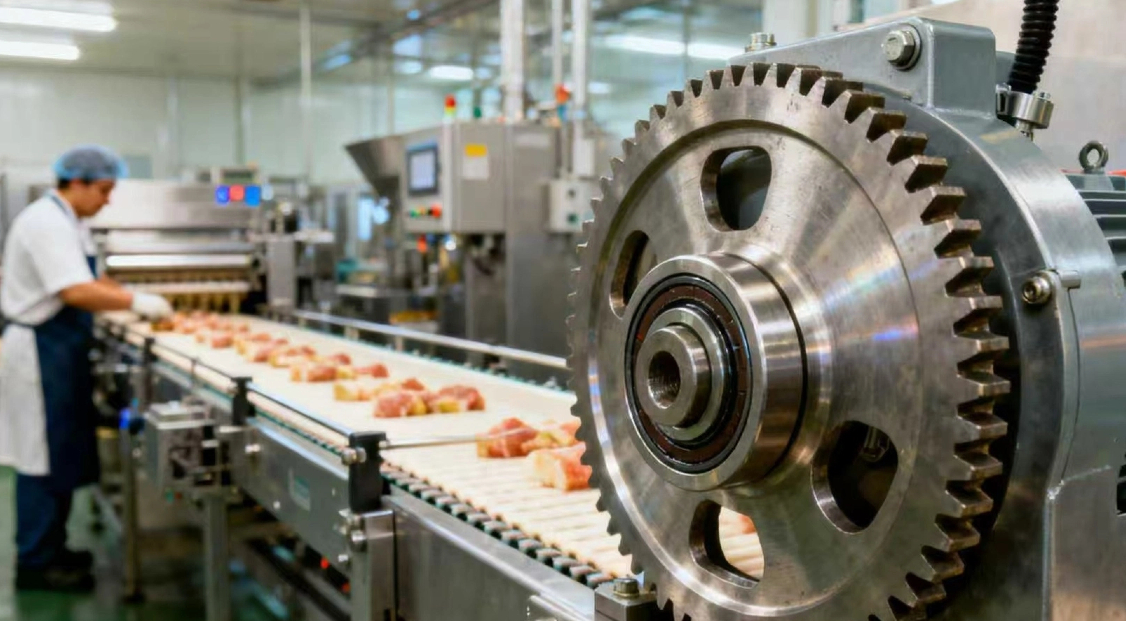
Application of Slew Drives in the Food Processing Industry
What Is A Slew Drive?
A Slew Drive, also commonly referred to as a Slewing Drive, is a highly integrated mechanical transmission unit. It combines a large-diameter bearing (typically a cross roller bearing or a four-point contact ball bearing), a worm gear set (or planetary gear set), sealing systems, and a housing into a single compact, robust assembly. Its primary function is to convert the rotary motion of an input shaft into a 360-degree continuous, slow-speed, high-torque rotary output. This output is capable of sustaining substantial radial, axial, and tilting moments while enabling precise positioning and providing a self-locking function.
Compared to traditional, dispersed combinations of "bearing + gear reducer + power source," the main advantages of a slew drive lie in its, high level of integration, compact design, exceptional rigidity, and simplified installation. The worm gear mechanism typically offers a non-backdrive high level of integration or self-locking feature, safely holding the position when power is cut or the drive is stopped, which is crucial for load security. Furthermore, modern slew drives are meticulously engineered with efficient sealing systems, achieving protection ratings up to IP65, IP66, or higher, effectively guarding against the ingress of dust, moisture, and corrosive agents.
It is precisely these characteristics—high torque density, precise motion control, reliable self-locking, robust durability, and excellent protective capabilities—that have allowed slew drives to transcend their traditional applications in construction machinery and solar tracking, finding a vital role in the demanding environment of the food processing industry.
Aligning with Industry Demands: The Logic Behind Slew Drive Application in Food Processing
The food processing industry imposes distinct and stringent requirements on equipment: hygiene and safety, high efficiency and continuity, flexibility and adjustability, and ease of cleaning and maintenance. The design and application of slew drives demonstrate remarkable alignment with these needs.
Compliance with Hygienic Design Principles: Modern food-grade slew drives employ stainless steel housings (e.g., 304 or 316L) or coatings compliant with food-contact material standards. Their surfaces are finished to a high polish, minimizing crevices and dead zones that could harbor microorganisms or product residue. The sealing systems prevent both the entry of external contaminants and the leakage of internal lubricants, thereby avoiding product contamination. This allows them to be used directly in wash-down environments (CIP - Clean-in-Place) or areas exposed to food materials.
Enabling Precise Process Control: Whether for mixing, stirring, filling, or sorting, precise angular displacement and speed control are paramount for consistent product quality. Slew drives, paired with servo or stepper motors, facilitate extremely accurate positioning and speed regulation, ensuring the exact replication of processing parameters.
Load Capacity and Space Efficiency: Food processing equipment, such as large mixing vessels, rotary retorts, and automated storage/retrieval system (AS/RS) stacker cranes, often requires rotating heavy loads. Slew drives consolidate the functions of load-bearing, power transmission, and rotation into a single unit. This saves valuable space within the machine, simplifies the mechanical structure, and enhances the overall system's rigidity and reliability.
Adaptation to Harsh Operating Conditions: Food processing environments may involve high-temperature steam, frequent high-pressure water/chemical wash-downs, low-temperature refrigeration, or high humidity. Specialized slew drives can be designed to operate reliably across a wide temperature range (e.g., -40°C to 120°C or beyond) while maintaining consistent lubrication and sealing performance over the long term.
Therefore, the application of slew drives in the food industry essentially represents the fusion of powerful engineering transmission solutions with rigorous food-grade hygiene standards, providing reliable motion "joints" for automated production lines.
Application Cases: From Raw Material Handling to Final Packaging
Slew drives have permeated various stages of food processing, as illustrated by these typical application cases:
<1 Large-Scale Food Mixing and Blending Equipment
In the production of baking ingredients, sauces, confectionery, or pet food, giant double-cone blenders or planetary mixers with volumes of several thousand liters are common. The bowls or mixing arms of these machines require complex rotary motions to achieve homogeneous blending. High-torque slew drives are mounted directly onto the machine's rotation axis to drive the entire bowl for 360-degree tumbling or to orchestrate the planetary motion of mixing arms. Their self-locking feature ensures safety when stopped at any angle, and their hygienic design permits thorough regular CIP cleaning.
<2 Rotary Sterilization and Cooking Systems
In the canned food, ready-meal, or beverage industries, rotary retorts are critical equipment. The baskets inside the retort rotate slowly and uniformly to ensure even heat distribution among the contents, improving sterilization efficiency and product quality. Slew drives are mounted at one end of the retort vessel, directly driving the main shaft (which runs through the vessel) and the baskets. They must withstand high-temperature, high-pressure environments (often above 121°C and several atmospheres of saturated steam). Their sealing and material selection are particularly critical, requiring long-term stable operation with zero risk of leakage.
<3 Automated Sorting and Palletizing Robots
At the end of production lines, following inspection by vision systems, high-speed Delta robots or articulated arm robots perform rapid picking, packing, or palletizing. The base rotation joint of many heavy-duty palletizing robots employs high-performance slew drives. They provide the precise, rapid slewing motion required by the robot, along with the high moment stiffness needed to support the entire manipulator arm. Their maintenance requirements are also significantly lower than those of traditional gearbox combinations.
<4 Automated Storage and Retrieval Systems (AS/RS) and Material Transfer Systems
In modern food logistics centers, the stacker cranes within Automated Storage and Retrieval Systems (AS/RS) need to shuttle at high speeds along aisles and position themselves accurately at storage locations. The lifting mechanism on top of a stacker crane sometimes incorporates a slew drive to rotate the forks, adapting to different rack access directions. Similarly, on material transfer platforms or turntables between production lines, slew drives provide smooth, precise direction-changing and positioning functions.
<5 Adjustable Processing Stations and Filling Heads
On flexible production lines designed for quick product changeovers, the height and angle of processing stations (e.g., stamping, filling heads) or filling nozzles need to be adjustable. Compact slew drives coupled with servo motors can be easily integrated into support structures, enabling rapid, programmable switching between multiple positions and angles, thereby greatly enhancing production line flexibility.
Future Trends: Intelligence, Integration, and Sustainability
Driven by the trends of Industry 4.0 and smart manufacturing, the food processing industry is demanding more from its equipment, which will guide the future evolution of slew drive technology:
Integration of Intelligence and Condition Monitoring: Future "Smart Slew Drives" will feature embedded sensors (for temperature, vibration, torque) and IoT (Internet of Things) modules. They will enable real-time monitoring of operating status, lubrication condition, and wear levels, facilitating predictive maintenance and preventing unplanned downtime. Data can be fed directly into factory MES/ERP systems to optimize production scheduling and maintenance cycles.
Higher Hygiene Standards and Cleanability: Hygienic design will be pushed to new extremes. Zero-dead-space designs, more advanced surface treatments (e.g., nano-coatings), dry-running operation (eliminating grease) or the use of NSF H1 certified food-grade lubricants will become standard for high-end products. Quick-disconnect designs will also simplify deep cleaning and maintenance procedures.
Improved Energy Efficiency and Sustainability: Through optimization of gear geometry (e.g., using double-enveloping worm gears or higher-efficiency planetary-bevel gear combinations), the use of low-friction seals, and high-quality bearings, next-generation slew drives will reduce energy losses, lowering the carbon footprint over the equipment's lifecycle. Their inherent long service life and reliability also contribute to sustainable production.
Lightweighting and Material Innovation: For robotic applications requiring high-speed movement, lightweighting is essential. The use of high-strength aluminum alloy housings, composite materials, or topologically optimized structures can reduce weight while maintaining strength and rigidity, improving dynamic performance and reducing energy consumption.
Modularity and Plug-and-Play Solutions: To shorten design cycles for food machinery manufacturers, the provision of pre-assembled, pre-tested plug-and-play drive modules is becoming a trend. These modules highly integrate the slew drive, motor, brake, encoder, and controller, allowing end-users to simply connect power and communication cables for operation.
Slewing Bearing Manufacturer
Lyra Drive backed best engineers in the R&D, design, and manufacture the precise slewing bearings to continuously reach the customers’ demand. In order to minimize the risk of food contamination, designing a slewing ring that meets hygienic design principles is vital. Fenghe slewing bearing regards hygienic design as the most important principle. It can extend the life span while operation and cleaning schemes are very hard.
 WhatsApp
 sales@lyradrive.com
 +8613903880726