



Why Slew Drives Fail and How to Prevent It?
In the realm of heavy machinery and precision engineering, the slew drive is a true workhorse. This compact, powerful component enables controlled rotational movement in equipment ranging from massive construction cranes and wind turbines to precision solar trackers and industrial robots. Given its critical role in lifting, positioning, and supporting heavy loads, the reliable operation of a slew drive is paramount. A failure is not merely a component malfunction; it can lead to catastrophic equipment breakdowns, costly project delays, expensive repairs, and, most critically, severe safety hazards for personnel. Understanding why these drives fail and, more importantly, how to prevent such failures, is essential for anyone who operates, maintains, or designs equipment that relies on them.
What is a Slew Drive?
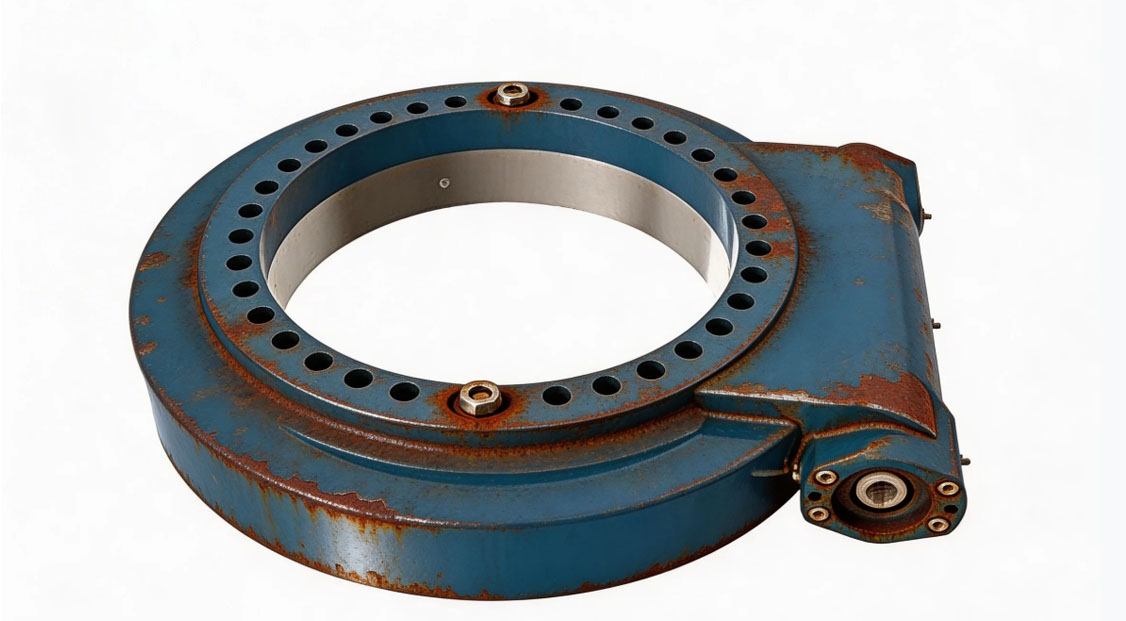
A slew drive is a sophisticated, fully integrated gearbox mechanism engineered to manage heavy loads during rotational motion. Think of it as a compact, high-capacity rotating platform. Its defining characteristic is its ability to simultaneously handle complex combinations of forces: axial loads (thrust along the rotation axis), radial loads (forces perpendicular to the axis), and tilting moment loads (forces that try to tip the assembly). This multi-load capability, packaged within a sealed, self-contained unit, distinguishes it from simpler rotation systems. Key features include a built-in slewing bearing for load support, a drive mechanism (like a worm or pinion gear) for motion control, and a protective housing that retains lubrication and seals out contaminants.
How Does a Slew Drive Work?
The operating principle of a slew drive is both elegant and effective. An external power source—such as a hydraulic motor, electric motor, or even a manual hand crank—turns an input shaft. This shaft is connected to a drive mechanism, most commonly a worm gear. The worm gear meshes with gear teeth that are cut directly into the inner or outer race of the integrated slewing bearing. As the worm rotates, it drives the bearing’s ring to rotate. This gear arrangement provides a significant speed reduction in a single stage, converting high-speed input power into slow, powerful, and highly controlled rotational output. A notable feature of many worm gear slew drives is their inherent self-locking capability; the friction between the worm and the gear often prevents the load from back-driving the motor, providing a natural safety brake.
Advantages of Slew Drives
Slew drives are favored across industries for several compelling reasons:
Compact & Integrated Design: By combining a bearing, gearbox, and housing into one unit, they save significant space and simplify machine design.
High Load Capacity: They are engineered to simultaneously manage axial, radial, and moment loads, making them ideal for demanding applications.
Self-Locking Capability: The inherent self-locking feature in worm gear designs enhances safety by preventing unintended load movement.
Precision & Smoothness: They provide smooth, controlled motion with minimal backlash, essential for accurate positioning.
Durability & Low Maintenance: The sealed housing protects internal components from harsh environments, leading to long service life and reduced maintenance needs.
Some of the Most Frequent Causes of Slew Drive Failure
Despite their robust construction, slew drives can and do fail. Understanding the root causes is the first step in prevention. The most frequent culprits include:
Improper Lubrication: This is the leading cause of failure. Using the wrong type of lubricant, insufficient lubrication, or allowing the lubricant to become contaminated or break down leads to increased friction, excessive wear on gear teeth and bearings, and overheating.
Overloading and Shock Loads: Exceeding the drive's rated load capacity, or subjecting it to sudden, extreme shock loads, can cause immediate and catastrophic damage, such as gear tooth fracture, bearing raceway brinelling (permanent indentations), or even housing cracks.
Contamination Ingress: The failure of seals allows dirt, dust, water, and other abrasive particles to enter the drive. These contaminants act as grinding paste, rapidly wearing down precision-ground gear teeth and bearing surfaces.
Misalignment: Incorrect mounting of the slew drive or the mating structure can create uneven stress distribution. This leads to premature wear on specific areas of the gear teeth and bearings, reducing the drive's effective life.
Bearing Fatigue and Wear: Even under normal operating conditions, the rolling elements and raceways within the integrated slewing bearing are subject to continuous stress. Over millions of cycles, material fatigue can occur, leading to spalling (flaking of the material) and increased vibration.
Corrosion: In marine or chemical environments, or where seal failure has occurred, moisture can lead to rust and corrosion on precision surfaces. Corrosion creates rough spots that accelerate wear and compromise the drive's integrity.
Preventive Measures for Slew Drive Failure
Preventing failure is far more cost-effective than dealing with its consequences. A proactive approach involves several key practices:
Adhere to a Strict Lubrication Schedule: Follow the manufacturer's recommendations meticulously regarding lubricant type, quantity, and re-lubrication intervals. Use high-quality, specified lubricants and monitor for signs of contamination or degradation.
Respect Load Ratings: Never exceed the drive's rated dynamic and static load capacities. When designing applications, include a suitable safety factor to account for unexpected peak loads and impacts.
Ensure Proper Installation: Follow precise installation procedures. This includes correctly aligning the drive with the mating structure, using the correct bolts tightened to the specified torque, and ensuring the mounting surface is flat and rigid.
Maintain Seal Integrity: Regularly inspect seals for damage, cracking, or leakage. Replace worn seals immediately to prevent contaminants from entering the drive. In harsh environments, consider additional protective measures like boots or covers.
Implement Condition Monitoring: Regularly monitor the drive for signs of trouble. This includes listening for unusual noises (grinding, clicking), feeling for excessive vibration, checking for smoothness of rotation, and analyzing grease samples for metal particles.
Periodic Inspections: Conduct thorough, scheduled inspections. Check for any signs of corrosion, loose mounting bolts, leaks, or visible damage. For critical applications, non-destructive testing methods can identify internal flaws before they lead to failure.
Conclusion
Slew drives are remarkably reliable components that form the rotational backbone of countless machines. Their failure, however, can have severe operational and safety implications. By understanding their function, respecting their limits, and implementing a robust preventive maintenance program focused on lubrication, contamination control, and proper installation, the risk of unexpected failure can be dramatically reduced. Proactive care is the key to maximizing the lifespan of your slew drive, ensuring the safety of your operations, and avoiding costly downtime.
LyraDrive: Get Custom Slew Drive Solutions & 3D Drawings for Your Project
When reliability and performance are non-negotiable, partnering with an experienced manufacturer is your best strategy. LyraDrive is a specialized manufacturer with years of expertise in producing high-quality slew drives and slewing bearings. We understand that every application is unique, which is why we offer a comprehensive range of drive types to meet diverse industrial needs, including worm gear slew drives, double worm slew drives, and spur gear slew drives. Whether you require a standard unit or a fully custom-engineered solution, LyraDrive has the capability to deliver.
We believe that clear visualization is the first step toward a perfect fit. That's why LyraDrive offers a collaborative engineering process. By analyzing your specific application data—including load requirements, speed, torque, and environmental conditions—our experienced team can generate a detailed 3D drawing of your custom slew drive. This digital model allows you to visualize the component within your assembly, verify dimensions and interfaces, and gain a clear, intuitive understanding of the solution before any metal is cut. This approach ensures that the final product integrates seamlessly into your machinery, meeting your exact specifications for performance and durability. From concept to delivery, LyraDrive is your partner for reliable, precision-engineered rotational solutions.
FAQ
Q1: How often should I lubricate my slew drive?
A: Lubrication frequency depends on the drive's usage intensity, operating environment, and the manufacturer's specifications. As a general rule, drives in continuous, heavy-duty service may require weekly or monthly lubrication, while those in intermittent use might be serviced quarterly or annually. Always consult your drive's manual for the specific schedule.
Q2: What are the first signs of slew drive failure?
A: Early warning signs often include unusual noises (such as grinding, clicking, or humming), increased vibration, rough or jerky rotation, and visible signs of lubricant leakage around the seals. Monitoring for these changes can help catch problems early.
Q3: Can an overloaded slew drive be repaired, or must it be replaced?
A: It depends on the extent of the damage. Minor brinelling or surface wear might be remediable, but severe damage like cracked gear teeth, deformed raceways, or a bent housing typically necessitates complete replacement. A thorough inspection by a qualified technician is essential to make this determination.
Q4: What is the difference between a worm gear and a spur gear slew drive?
A: The main difference lies in their mechanism and characteristics. Worm gear drives offer high reduction ratios, smoother and quieter operation, and inherent self-locking. They are ideal for applications where holding a load is critical. Spur gear drives are typically more efficient and can handle higher speeds but may have more backlash and are not self-locking. They are often used in precision positioning applications where low backlash is key.
Q5: Why is seal integrity so important for a slew drive?
A: Seals are the primary defense against contamination. They keep lubricant in and harmful substances like dust, water, and grit out. Once a seal fails, contaminants can quickly enter the drive, acting as an abrasive that will rapidly wear down precision gear teeth and bearing surfaces, leading to premature failure.
Q6: How do I choose the right slew drive for a new application?
A: Selecting the right drive involves analyzing several key factors: the maximum loads (axial, radial, and moment), required rotational speed and torque, duty cycle, operating environment (temperature, humidity, contaminants), and desired service life. Consulting with a manufacturer like LyraDrive, who can analyze your data and provide engineered recommendations, is the best way to ensure you select the optimal drive.
Q7: Does LyraDrive provide support for integrating their slew drives into existing machinery?
A: Yes, absolutely. LyraDrive's engineering team can work with you to design custom solutions, including adapting existing equipment. By providing 3D models and detailed engineering support, we help ensure that our slew drives integrate seamlessly and perform reliably within your machinery.
 WhatsApp
 sales@lyradrive.com
 +8613903880726