



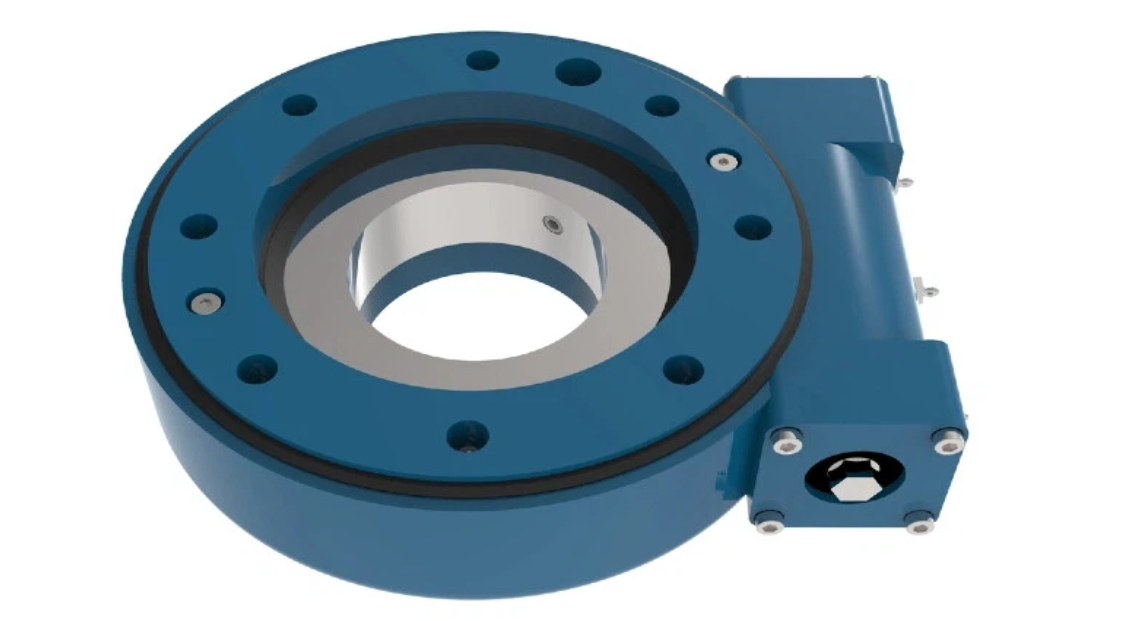
What Is Slew Drive Torque and Why Does It Matter?
Slew drives are compact yet powerful rotational components widely used in heavy machinery, solar tracking systems, cranes, and industrial automation. At the heart of every slew drive lies a critical parameter that determines its performance, safety, and application suitability: torque. Understanding what slew drive torque is, the different types involved, and why it matters can make the difference between a reliable system and one prone to failure or underperformance.
What Is a Slew Drive and How Does It Work?
A slew drive is a precision-engineered rotational device designed to handle heavy loads while providing smooth, controlled rotation. It typically consists of a worm gear, a slewing ring (bearing), a housing, and various sealing components.
The working principle is based on the worm-and-wheel mechanism. The worm, which is the input shaft, meshes with a gear (worm wheel) integrated into the slewing ring. When the worm rotates, it drives the wheel, creating rotational motion. One of the key advantages of this design is self-locking: in most worm-driven slew drives, the worm cannot be back-driven by the load, providing inherent braking and position-holding capability without external brakes.
This combination of high load capacity, compact form factor, and self-locking functionality makes slew drives ideal for applications requiring precise positioning under heavy loads.
What Is the Torque of a Slew Drive?
Torque, in the context of a slew drive, is the rotational force transmitted from the input shaft to the output (the rotating ring). It is typically expressed in Newton-meters (N·m) or foot-pounds (lb-ft).
Torque is the fundamental parameter that defines what a slew drive can accomplish. It determines whether the drive can start rotating under load, maintain continuous operation, and hold position safely when stationary. Selecting a slew drive without properly understanding its torque characteristics often leads to premature wear, system failure, or safety risks.
Core Torque Types in Slew Drives
Understanding the different torque types associated with slew drives is essential for proper selection and safe operation. In practice, four core torque types define a slew drive’s capability across various operating conditions.
Static Torque
Static torque refers to the maximum torque a slew drive can withstand while stationary without causing permanent deformation or failure. It represents the drive’s holding capacity under a fixed load.
Key characteristic: No relative movement between components
Application relevance: Critical for applications requiring long-term position holding, such as solar trackers, crane outriggers, or aerial work platforms
Typical limiting factor: Gear tooth strength, housing rigidity, and bearing capacity
Dynamic Torque
Dynamic torque is the maximum continuous torque a slew drive can transmit while in motion. This value determines the drive’s ability to rotate loads under normal operating conditions.
Key characteristic: Sustained rotational movement with load
Application relevance: Defines the working capacity for rotating applications like crane turntables, excavators, and industrial positioners
Typical limiting factor: Worm and wheel gear mesh durability, lubrication conditions, and thermal dissipation
Holding Torque
Holding torque is the torque required to prevent a loaded slew drive from rotating when the input power is removed. In worm-driven slew drives, this is often achieved through the self-locking characteristic of the worm gear mechanism.
Key characteristic: Maintains position without external braking (in self-locking designs)
Application relevance: Essential for safety in applications where power loss must not result in uncontrolled movement, such as solar trackers, wind turbine yaw systems, and lifting equipment
Typical limiting factor: Worm lead angle, friction coefficient, and gear meshing efficiency
Breakaway Torque (Starting Torque)
Breakaway torque, also known as starting torque, is the initial torque required to overcome static friction and inertia to start the slew drive rotating from a standstill. This value is typically higher than the dynamic torque due to the “stiction” effect between the worm and wheel, bearing preload, and seal resistance.
Key characteristic: Peak torque at startup; transient by nature
Application relevance: Directly impacts motor sizing; insufficient breakaway torque can cause motor stalling or failure to initiate rotation, especially in low-temperature environments or after extended idle periods
Typical limiting factor: Bearing preload, seal drag, lubricant viscosity, and the static friction coefficient of the worm-wheel interface
Summary Comparison
| Torque Type | Condition | Primary Concern |
|---|---|---|
| Static Torque | Stationary, loaded | Structural integrity |
| Dynamic Torque | Continuous rotation | Operational capacity |
| Holding Torque | Power-off, load applied | Safety & position retention |
| Breakaway Torque | Startup from rest | Motor sizing & reliability |
Practical Tip: When selecting a slew drive, always verify that the breakaway torque does not exceed the starting capacity of your drive motor or hydraulic system. In many applications, breakaway torque is the overlooked factor that leads to “under-motorized” systems that fail to start reliably.
Factors Influencing Torque in Slew Drives
Several factors determine the torque capacity and torque efficiency of a slew drive:
Size and Geometry: Larger slew drives with greater pitch diameters and larger gear teeth inherently handle higher torque loads. The overall dimensions directly correlate with torque capacity.
Material Selection: The worm is typically made from hardened steel, while the worm wheel often uses bronze or other wear-resistant alloys. Material choices significantly affect both torque capacity and longevity.
Heat Treatment and Surface Finishing: Proper heat treatment of the worm and appropriate surface finishes reduce friction and wear, allowing higher torque transmission with improved efficiency.
Gear Ratio: Higher gear ratios generally produce higher output torque for a given input, though they reduce output speed. The relationship follows the basic principle of mechanical advantage.
Bearing Type: The slewing ring bearing—often a cross-roller or four-point contact ball bearing—affects rotational resistance and torque efficiency. High-quality bearings reduce friction and improve overall torque performance.
Seals and Lubrication: Seals protect internal components but add rotational resistance. Lubricant type and viscosity also influence breakaway torque and dynamic torque efficiency, particularly in extreme temperatures.
Importance of Torque in Slew Drives
Torque is not just a specification—it is the defining characteristic that determines whether a slew drive will perform reliably in its intended application.
Sizing and Selection: The most immediate importance of torque lies in proper sizing. Undersizing leads to premature failure, while oversizing adds unnecessary cost and weight. Accurate torque analysis ensures the drive matches the application’s demands.
Safety: In lifting and positioning applications, insufficient torque—particularly holding torque—can result in unintended movement, posing serious safety risks. Self-locking worm drives provide inherent safety by preventing back-driving.
System Longevity: Operating within a slew drive’s torque ratings prevents excessive wear on gear teeth, bearings, and seals. Consistently exceeding rated torque accelerates fatigue and reduces service life.
Application Compatibility: Different applications prioritize different torque characteristics. Solar trackers require high holding torque with minimal dynamic demands, while crane turntables demand robust dynamic torque with frequent start-stop cycles.
Typical Slew Drive Torque Applications
Slew drives serve across diverse industries, each with distinct torque requirements:
| Application | Primary Torque Priority | Typical Torque Range |
|---|---|---|
| Solar Tracking Systems | Holding torque, breakaway torque | 1,000 – 15,000 N·m |
| Crane Turntables | Dynamic torque, static torque | 5,000 – 100,000+ N·m |
| Aerial Work Platforms | Static torque, holding torque | 2,000 – 25,000 N·m |
| Wind Turbine Yaw Systems | Dynamic torque, holding torque | 10,000 – 80,000 N·m |
| Industrial Rotary Tables | Dynamic torque, precision | 500 – 10,000 N·m |
| Excavator Swing Drives | Dynamic torque, breakaway torque | 8,000 – 60,000 N·m |
In solar tracking, for example, the slew drive must maintain position against wind loads throughout the day while reliably breaking away from stationary friction at dawn. In crane applications, dynamic torque determines lifting capacity and swing speed, while static torque ensures stability during loading operations.
How to Select and Optimize Torque for Slew Drives
Selecting the right slew drive involves more than simply matching a torque number from a datasheet. A systematic approach ensures optimal performance and longevity.
Basic Calculation Approach
The required torque can be approximated using the fundamental torque equation:
T = F × r
Where:
T = Required torque (N·m)
F = Total load force (N), including weight, wind load, and inertial forces
r = Radius from rotation center to load center (m)
For more complex applications, additional factors must be considered:
Friction torque from bearings and seals
Inertial torque during acceleration and deceleration
External forces such as wind, inclined surfaces, or shock loads
Safety factor (typically 1.5 to 3.0 depending on application criticality)
Optimization Considerations
Motor Matching: Ensure the drive motor provides sufficient breakaway torque, not just dynamic torque. Many systems fail at startup despite adequate running torque capacity.
Environmental Conditions: Low temperatures increase lubricant viscosity, raising breakaway torque. High temperatures may reduce lubricant effectiveness and affect dynamic torque ratings.
Installation Precision: Proper alignment during installation minimizes parasitic torque losses. Misalignment increases friction and accelerates wear.
Maintenance Practices: Regular lubrication with the specified lubricant type maintains torque efficiency. Contaminated or degraded lubricant increases friction and reduces torque capacity over time.
Application-Specific Customization: Standard off-the-shelf slew drives may not perfectly match unique application requirements. Customization allows optimization of torque characteristics, mounting interfaces, and sealing arrangements for specific operating conditions.
LyraDrive: High-Quality Slew Drive Manufacturer
At LyraDrive, we specialize in engineering and manufacturing high-performance slew drives and slewing bearings for demanding applications worldwide. Our product portfolio encompasses three primary types to address diverse torque requirements:
Worm Gear Slew Drives: The classic configuration offering excellent self-locking capability and high holding torque, ideal for solar tracking, aerial lifts, and positioning applications where safety and position retention are paramount.
Double Worm Slew Drives: Featuring dual worm inputs, this design delivers higher torque density and reduced backlash, making it suitable for precision applications such as industrial automation and radar systems where accuracy and reliability are critical.
Spur Gear Slew Drives: Designed for applications requiring higher rotational speeds and continuous motion, spur gear configurations provide efficient torque transmission without self-locking, commonly used in material handling and conveyor systems.
What sets LyraDrive apart is our commitment to customization. We understand that each application presents unique torque demands, mounting constraints, and environmental challenges. Our engineering team works closely with clients to tailor every aspect—from gear ratios and housing configurations to sealing systems and lubrication—ensuring optimal torque performance for your specific use case. Whether you require precise holding torque for solar tracking or robust dynamic torque for heavy machinery, LyraDrive delivers solutions engineered to perform.
FAQ of Slew Drive Torque
Q1: What happens if I choose a slew drive with insufficient torque?
Insufficient torque leads to premature wear, overheating, motor stalling, and eventual failure. In safety-critical applications, it may result in unintended movement or load dropping.
Q2: What is the difference between static torque and holding torque?
Static torque is the structural limit under stationary load without movement. Holding torque specifically refers to the torque required to maintain position when power is removed, often leveraging self-locking characteristics.
Q3: How does temperature affect slew drive torque?
Low temperatures increase lubricant viscosity, raising breakaway torque. High temperatures may reduce lubricant film strength, potentially lowering dynamic torque capacity if not properly managed with appropriate lubricants.
Q4: Can I increase torque by using a larger motor?
Increasing motor input torque without verifying the slew drive’s rated capacity risks mechanical failure. Always ensure the slew drive’s maximum torque ratings exceed the motor’s output.
Q5: Why is breakaway torque often higher than dynamic torque?
Breakaway torque must overcome static friction, seal resistance, and bearing preload from a standstill. Once moving, dynamic friction is typically lower, requiring less torque to maintain motion.
Q6: Are all worm gear slew drives self-locking?
Not all worm gear drives are self-locking. Self-locking depends on the worm lead angle and friction characteristics. Most standard slew drives are designed with self-locking capability, but this should be verified for each specific model.
Q7: How often should I check torque performance in an operating slew drive?
Regular inspection of lubrication condition, unusual noise, and rotational resistance is recommended. Significant increases in operating torque often indicate wear, contamination, or misalignment requiring attention.
 WhatsApp
 sales@lyradrive.com
 +8613903880726