



What Are Slew Drive Assemblies?
What Is a Slew Drive?
A slew drive is a precision-engineered mechanical device designed to facilitate controlled rotational movement in heavy-duty applications. Often referred to as a slewing drive or slewing ring drive, it combines a slewing bearing (a large-diameter bearing capable of handling axial, radial, and tilting moment loads) with a housing, worm shaft, and often a motor interface. The primary function of a slew drive is to provide smooth, accurate, and self-locking rotational motion, making it indispensable in industries such as solar tracking, construction machinery, aerial work platforms, and industrial automation. Unlike conventional rotational systems, a slew drive is engineered to deliver high torque output in a compact form factor while maintaining positional stability even under extreme external forces.
The Features of Slew Drives
Slew drives are distinguished by several key features that set them apart from traditional rotation mechanisms:
High Load Capacity: They are capable of simultaneously supporting axial loads, radial loads, and tilting moment loads, making them ideal for applications where stability is critical.
Self-Locking Capability: The worm gear configuration in most slew drives provides a natural self-locking function, preventing reverse rotation and enhancing safety, particularly in lifting and aerial equipment.
Compact Design: By integrating the bearing, gear, and housing into a single unit, slew drives save significant space compared to traditional gearbox-and-bearing combinations.
Precision Positioning: With low backlash options available, slew drives enable highly accurate angular positioning, essential for applications like solar trackers and radar systems.
Durability: Constructed with high-grade materials, heat-treated gears, and robust seals, slew drives are built to withstand harsh environments, including extreme temperatures, moisture, and dust.
What Are the Slew Drive Assembly?
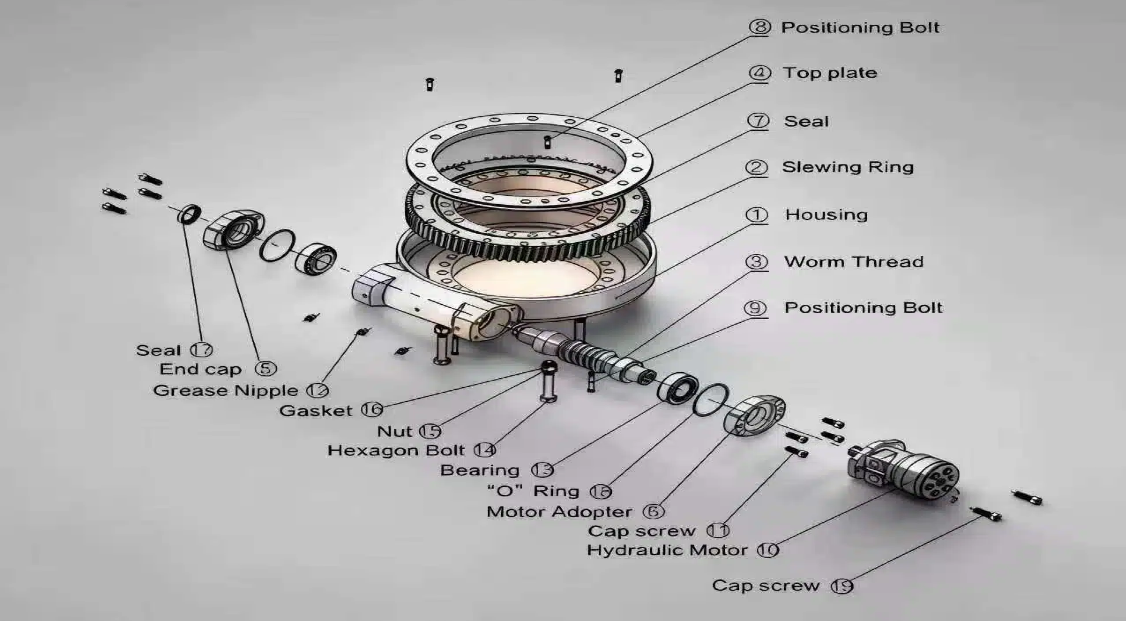
A slew drive assembly refers to the complete integrated system comprising multiple precisely engineered components that work in unison to achieve controlled rotary motion. Unlike a standalone bearing or gearbox, the assembly is designed as a ready-to-install unit, simplifying equipment design and reducing assembly time for manufacturers.
The assembly can be broken down into four primary subsystems:
a. The Slewing Bearing (Raceway and Gears)
At the heart of the assembly lies the slewing bearing, which consists of an inner race and an outer race, typically with rolling elements such as balls or crossed rollers between them. One race incorporates internal or external gear teeth that mesh with the driving worm. This bearing not only supports the load but also serves as the rotating interface.
b. The Housing
The housing is a precision-machined enclosure, usually made from high-strength cast iron or steel. It encases the worm shaft and provides mounting points for the motor or hydraulic motor. The housing also serves as a protective barrier, shielding internal components from contaminants. In many slew drive assemblies, the housing is integrated with one race of the slewing bearing, creating a monolithic structure that enhances rigidity and alignment.
c. The Worm Shaft
The worm shaft is a hardened, ground-threaded component that engages with the gear teeth on the slewing bearing. It acts as the driving element, translating rotational input from a motor into controlled rotary motion of the bearing. Depending on the application, worm shafts can be single-enveloping or double-enveloping designs to increase contact area and load capacity.
d. Sealing and Lubrication Systems
A complete assembly includes advanced sealing systems—typically multiple lip seals or labyrinth seals—to prevent ingress of water, dust, and debris while retaining lubricant. Grease zerks or oil ports are integrated into the housing to facilitate routine maintenance.
In essence, the slew drive assembly represents a complete, pre-engineered rotational solution that eliminates the need for engineers to design separate bearing, gear, and housing interfaces, thereby reducing potential failure points and improving overall system reliability.
How Do the Various Components Work?
The functionality of a slew drive assembly is best understood by examining the interaction between its core components during operation.
Power Transmission and Speed Reduction
When an external power source—such as an electric motor, hydraulic motor, or manual crank—drives the worm shaft, the worm’s helical threads engage the gear teeth on the slewing bearing’s race. This engagement creates a high-reduction ratio in a single stage. For every full rotation of the worm shaft, the slewing bearing advances by only one tooth increment, resulting in exceptionally high torque output with precise speed control. This configuration allows heavy loads to be rotated smoothly without requiring large gearboxes.
Load Distribution and Support
As the slewing bearing rotates, the rolling elements (balls or crossed rollers) distribute the applied loads across the raceways. The design of the bearing ensures that axial loads (vertical forces), radial loads (horizontal forces), and tilting moment loads (forces causing overturning) are all absorbed within the compact structure. The crossed roller design, commonly used in precision slew drives, provides higher rigidity and accuracy by arranging rollers perpendicular to one another within a single raceway.
Self-Locking Mechanism
In worm-driven slew drives, the self-locking characteristic is a critical functional feature. The lead angle of the worm is designed such that the friction between the worm and the gear teeth prevents the gear from back-driving the worm. This means that when the driving motor stops, the load remains securely held in position without requiring external brakes. This is particularly vital for aerial work platforms, cranes, and solar trackers where unintended rotation could lead to equipment damage or safety hazards.
Backlash Control
Backlash—the slight play between meshing gear teeth—is managed through precision machining and, in advanced assemblies, adjustable designs. Some slew drive assemblies incorporate an eccentric housing or adjustable worm shaft that allows engineers to fine-tune the meshing clearance. In applications requiring extreme precision, such as radar antennas or medical equipment, low-backlash or zero-backlash slew drives are employed to ensure positioning accuracy within fractions of a degree.
Sealing and Protection
During operation, the relative motion between the housing and the rotating bearing creates potential entry points for contaminants. The sealing system works dynamically: as the assembly rotates, the seals maintain constant contact with rotating surfaces, creating a barrier. Simultaneously, lubricant is circulated (or retained in grease pockets) to reduce friction, dissipate heat, and prevent wear. Proper lubrication ensures that the rolling elements, raceways, and gear teeth maintain optimal surface integrity over extended service periods.
How to Maintain the Components of a Slew Drive?
Proper maintenance is essential to maximize the lifespan and performance of a slew drive assembly. Maintenance practices should focus on lubrication, inspection, and contamination control.
Lubrication Management
Regular lubrication is the most critical maintenance task. The type and frequency of lubrication depend on the application and operating environment. For grease-lubricated slew drives, high-quality lithium-complex or extreme-pressure (EP) greases are recommended. Re-greasing intervals should follow manufacturer guidelines, typically every 3 to 6 months under normal conditions, and more frequently in high-load, high-speed, or contaminated environments. Grease should be applied until fresh lubricant emerges from the seals, ensuring old, contaminated grease is expelled. For oil-lubricated units, oil levels must be checked regularly and changed according to operating hours.
Seal Inspection and Replacement
Seals are the first line of defense against environmental contaminants. During routine inspections, operators should check for signs of seal wear, cracking, or hardening. Damaged seals allow moisture and debris to enter, leading to accelerated wear of the gear teeth, rolling elements, and raceways. If leakage is observed, seals should be replaced promptly using manufacturer-specified components to maintain proper fit and performance.
Backlash and Torque Monitoring
Periodically, the assembly’s backlash should be measured to ensure it remains within acceptable limits. Increased backlash may indicate wear on the worm or gear teeth. In adjustable slew drive designs, corrective measures can be taken by readjusting the worm position. Additionally, unusual torque spikes or resistance during rotation often signal internal issues such as lubricant degradation, bearing damage, or gear misalignment.
Environmental Protection
For slew drives exposed to harsh environments—such as solar trackers in deserts, marine cranes, or mining equipment—external protective measures should be considered. Adding protective covers, applying anti-corrosion coatings, and ensuring that mounting surfaces remain clean and dry can significantly extend component life.
Scheduled Overhaul
Depending on duty cycles, a full overhaul may be required after several years of operation. This involves disassembling the unit, inspecting all internal components for wear, replacing worn rolling elements or seals, and reassembling with fresh lubricant. Adhering to a scheduled maintenance program not only prevents unexpected downtime but also ensures consistent positioning accuracy and safety compliance.
LyraDrive: High Quality Slew Drives Supplier
Luoyang LyraDrive is a professional one-stop slewing device manufacturer majored in design and development, customized production, sales, and service on slewing bearings and slewing drives. With years of engineering expertise, LyraDrive has established itself as a reliable partner for industries requiring robust, precision rotational solutions.
LyraDrive provides high-quality and customized slew bearings, slew drives, and gear rings for applications including truck cranes, excavators, manlifts, solar tracking systems, and industrial automation equipment. Our product portfolio features three core types of slew drives to meet diverse operational demands:
Worm Gear Slew Drive: The standard configuration offering excellent self-locking capability, high torque output, and reliable performance for general industrial applications.
Double Worm Slew Drive: Engineered for applications requiring enhanced precision and zero backlash, this design incorporates dual worm shafts to eliminate rotational play, making it ideal for high-accuracy positioning systems.
Spur Gear Slew Drive: Designed for high-speed rotation applications where self-locking is not required, spur gear slew drives deliver efficient power transmission with minimal friction.
In addition to our standard product line, LyraDrive specializes in custom engineering. Whether you require specific mounting interfaces, specialized sealing for extreme environments, non-standard gear ratios, or integrated motor adaptations, our technical team works closely with clients to develop tailored solutions that meet exact performance specifications.
If you are looking for a reliable slew drive supplier or need technical support for an upcoming project, feel free to contact LyraDrive. We are committed to delivering durability, precision, and long-term value through engineering excellence.
FAQ of Slew Drive Assembly
Q1: What components are included in a complete slew drive assembly?
A complete slew drive assembly typically includes a slewing bearing (with integrated internal or external gear teeth), a precision-machined housing, a hardened worm shaft, high-performance sealing systems, and lubrication ports. Some assemblies also feature adjustable backlash mechanisms or integrated motor mounting interfaces. Together, these components form a ready-to-install rotational unit.
Q2: What is the function of the worm shaft within the assembly?
The worm shaft is the driving component of the assembly. It transfers rotational input from a motor or manual crank to the slewing bearing via gear engagement. Its helical threads mesh with the gear teeth on the bearing’s race, providing high reduction ratios, torque multiplication, and—in most worm-type designs—self-locking capability that prevents reverse rotation when the drive is not powered.
Q3: How does the slewing bearing differ from a standard bearing in a slew drive assembly?
Unlike standard bearings that handle only radial or axial loads, the slewing bearing in a slew drive assembly is designed to simultaneously support axial loads, radial loads, and tilting moment loads. It also incorporates gear teeth on one race, allowing direct integration with the worm shaft. This multifunctional design eliminates the need for separate bearing and gear components.
Q4: Why are seals critical to the performance of a slew drive assembly?
Seals protect the internal components—particularly the gear mesh, rolling elements, and raceways—from contaminants such as dust, water, and debris. They also retain lubricant within the assembly. A compromised seal can lead to accelerated wear, increased friction, and premature failure. High-quality slew drive assemblies utilize multi-lip or labyrinth seals designed for harsh operating environments.
Q5: Can the backlash in a slew drive assembly be adjusted?
In many slew drive assemblies, yes. Some designs incorporate an eccentric housing or an adjustable worm shaft positioning mechanism that allows engineers to fine-tune the meshing clearance between the worm and the gear teeth. This adjustability is essential for maintaining precision in applications such as solar trackers, radar systems, and automation equipment where positional accuracy is critical.
Q6: What maintenance procedures are recommended for a slew drive assembly?
Routine maintenance includes regular re-greasing or oil level checks, inspection of seals for wear or damage, monitoring backlash levels, and checking for unusual noise or resistance during operation. Following the manufacturer’s recommended lubrication schedule and promptly addressing any seal damage are the most effective ways to extend the service life of the assembly.
Q7: How do I determine the correct size and type of slew drive assembly for my application?
Selection is based on several factors: the magnitude and direction of loads (axial, radial, and moment), required rotational speed, duty cycle, environmental conditions (temperature, moisture, exposure), and precision requirements. Consulting with an experienced manufacturer ensures that the assembly’s static and dynamic load ratings, gear ratio, backlash class, and mounting configuration align with the specific demands of your equipment.
Q8: What is the difference between a worm slew drive and a spur gear slew drive assembly?
A worm slew drive uses a worm shaft to engage with the gear teeth, providing high reduction ratios and inherent self-locking capability, making it ideal for lifting, positioning, and safety-critical applications. A spur gear slew drive uses a spur pinion to drive the gear, offering higher rotational speeds and efficiency but without self-locking. The choice depends on whether speed or positional holding is the priority.
 WhatsApp
 sales@lyradrive.com
 +8613903880726