



The Ultimate Slew Drive Lubrication and Maintenance Guide
What is a Slew Drive?
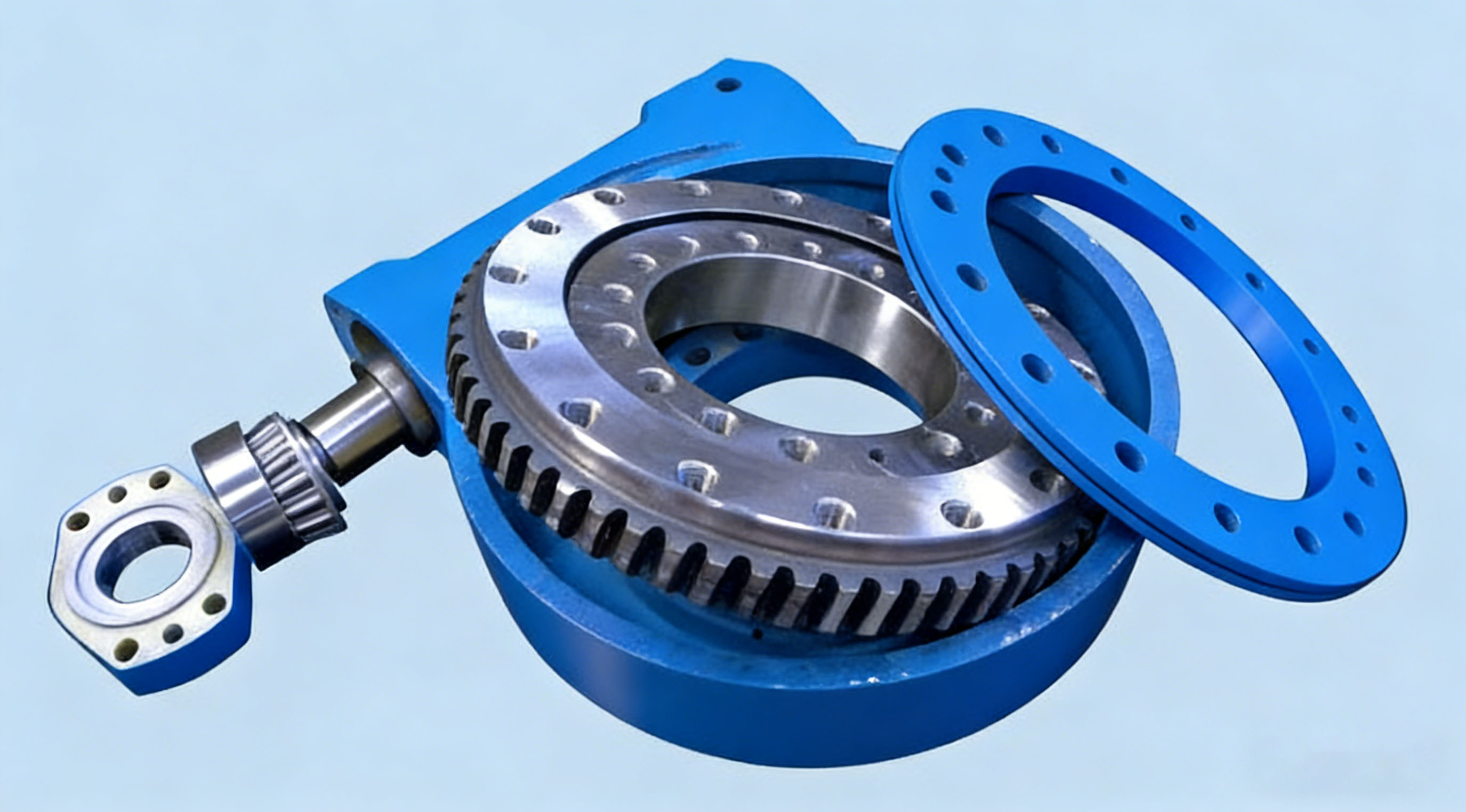
A slew drive is a compact, integrated rotary actuator that combines a slewing bearing, worm gear mechanism, sealing system, and housing into one ready-to-install unit. These precision components are specifically designed to handle high radial, axial, and moment loads simultaneously while providing rotational positioning.
How Does a Slew Drive Work?
A slew drive operates on the worm and worm gear principle. The input shaft features a threaded worm that engages with teeth on the outer diameter of the slewing ring (the worm wheel). As the worm rotates, it advances the ring incrementally.
This configuration offers two significant advantages:
High reduction in a single stage – A single-turn input can advance the output by only one tooth, creating substantial torque multiplication. The output speed depends on the ratio of threads on the worm gear to the number of teeth on the worm wheel.
Self-locking capability – Depending on the lead angle, the worm can prevent the output from back-driving the input. This is critical for safety in applications like aerial work platforms and suspended loads.
The power transmission sequence is straightforward:
An electric motor, hydraulic motor, or manual crank delivers rotational force to the worm shaft
The helical thread of the worm shaft engages with the teeth of the worm wheel
This converts the worm's rotational motion into orbital rotation of the slewing ring
Integrated bearings distribute loads evenly during rotation
The self-locking feature stops rotation if power is lost
Why is Slew Drive Lubrication Important?
Research shows that over 80% of slew drive failures can be traced back to improper lubrication. This statistic alone demonstrates why lubrication deserves your attention.
Proper lubrication serves several critical functions:
Friction Reduction – Lubrication creates a film between moving surfaces—the worm gear meshing with the worm wheel teeth and the rolling elements within the bearing raceways. Without this film, metal-to-metal contact causes rapid wear and heat generation.
Heat Dissipation – The friction generated during operation produces heat. Lubricant helps carry this heat away from critical contact points, preventing thermal damage and maintaining proper clearances.
Corrosion Protection – Slew drives often operate in harsh environments. A quality lubricant forms a protective barrier on metal surfaces, preventing rust and corrosion that can compromise both the bearing and gear teeth.
Contamination Control – Fresh lubricant helps flush out wear particles and contaminants, carrying them away from load-bearing surfaces and toward seals where they can be expelled.
Extended Service Life – A well-lubricated slew drive can operate reliably for decades. Neglected lubrication leads to premature failure, costly repairs, and unexpected downtime.
Signs Your Slew Drive Needs Lubrication
Your slew drive will tell you when it needs attention—you just need to know what to listen and look for:
Unusual Noises – Grinding, clicking, or popping sounds during rotation often indicate insufficient lubrication, contaminant ingestion, or bearing/gear damage. A properly lubricated drive operates smoothly and quietly.
Increased Backlash or Play – If you notice a "loose" feeling or excessive free movement in rotation, the gear mesh may be worn or pre-load has been lost. This can result from inadequate lubrication allowing accelerated wear.
Difficulty Rotating or Jerky Movement – This can signal severe internal damage, failed bearings, or a complete lack of lubrication.
Visible Grease Leakage – While a small purge during lubrication is normal, continuous leaking points to failed seals that need immediate replacement. This also means lubricant is escaping and contaminants can enter.
Overheating – If the drive housing feels abnormally hot during operation, it may indicate insufficient lubrication or the wrong lubricant type.
Increased Operating Noise – Any change in the normal sound pattern deserves investigation.
How to Lubricate a Slew Drive :Step-by-Step Guide
Proper lubrication technique is just as important as lubrication frequency. Following these steps ensures your slew drive receives complete, effective lubrication that maximizes service life.
Step 1: Clean Before Lubricating
This is the most critical—and most overlooked—step in the entire process. 70% of contamination enters slew drives during lubrication when dirt around the fitting is forced directly into the bearing raceways and gear mesh.
Before you even pick up your grease gun:
Inspect the area – Examine all grease fittings and the surrounding surfaces. Look for built-up dirt, old grease, mud, or debris.
Thoroughly clean – Use a stiff brush, rag, or compressed air to remove all contamination from around each fitting. Pay special attention to the fitting tip where the grease gun will attach.
Check fitting condition – If any grease fitting is damaged, clogged, or missing, replace it before proceeding. A damaged fitting guarantees contamination entry.
Clean your tools – Wipe the nozzle of your grease gun clean. A dirty grease gun nozzle defeats the purpose of cleaning the fitting.
Remember: Forcing dirty grease through a clean fitting is like washing your face with a dirty towel. Take the extra minute to clean first—your slew drive's internal components will thank you.
Step 2: Select the Right Lubricant
Using the correct lubricant is non-negotiable for slew drive longevity. Most slew drives require high-viscosity, extreme-pressure (EP) lithium-based grease, but specific requirements vary by application.
The table below provides general guidance for lubricant selection based on operating conditions. Always consult your slew drive manufacturer's specifications as the primary reference.
Table 1: Recommended Slewing Drive Lubricants by Operating Conditions
| Operating Condition | Lubricant Type | NLGI Grade | Key Properties | Common Applications |
|---|---|---|---|---|
| Standard Industrial (Normal loads, moderate temperatures) | EP Lithium Grease | 1 or 2 | Good mechanical stability, water resistance, EP additives | General construction, material handling, standard cranes |
| Heavy Shock Loads | Heavy-Duty EP Grease with Moly | 1 or 2 | Molybdenum disulfide additive, high film strength | Mining equipment, excavators, heavy-duty cranes |
| High Temperature (>80°C / 176°F) | High-Temperature EP Grease | 2 or 3 | High drop point, oxidation resistant | Steel mills, foundries, hot environment applications |
| Low Temperature (<-20°C / -4°F) | Low-Temperature Synthetic Grease | 1 or 1.5 | Synthetic base oil, low pour point | Arctic operations, cold storage, winter outdoor equipment |
| Food Processing | Food-Grade (NSF H1) Grease | 2 | Non-toxic, odorless, tasteless | Food and beverage manufacturing equipment |
| Marine/Salt Water | Marine Grease with Corrosion Inhibitors | 2 | Excellent water resistance, rust prevention | Shipboard cranes, dockside equipment, offshore platforms |
| High Dust/Debris | High-Viscosity EP Grease with Tackifiers | 2 | Tacky consistency, good adherence | Desert operations, quarries, concrete plants |
| Slow Speed/High Load | Open Gear Grease or Semi-Fluid EP Grease | 0 or 00 | High viscosity, excellent adhesion | Large rotating structures, kilns, heavy industrial |
Key selection factors to consider:
Base oil viscosity – Must be sufficient to maintain film thickness under operating loads
EP additives – Essential for protecting against shock loads and boundary lubrication conditions
Base oil type – Mineral vs. synthetic (synthetics offer wider temperature range but cost more)
Compatibility – If changing lubricant type, completely purge the old grease first
Manufacturer approval – Always verify your selection meets the original equipment specifications
At LyraDrive, we can provide proper lubrication method guidance and analysis for your specific slew drive application. Contact our engineering team for recommendations tailored to your operating conditions.
Step 3: Locate All Lubrication Points
Before applying grease, identify every point requiring lubrication. Most slew drives have multiple grease fittings (zerks) at specific locations:
Slewing bearing raceways – Typically one or more grease fittings on the outer ring, often spaced around the circumference
Worm shaft bearings – Usually located at one or both ends of the worm housing
Gear mesh area – Some designs include direct lubrication access to the worm/worm wheel interface
Mounting flange – Occasionally, secondary seals or auxiliary components require lubrication
Consult your drive's maintenance manual for exact locations and quantities. If you have a custom LyraDrive unit, we provide detailed lubrication point diagrams with every shipment. Mark these points on the equipment itself with paint or tags for quick reference during future maintenance.
Step 4: Apply Lubricant Correctly
With everything clean and ready, it's time to apply the lubricant using proper technique:
Attach the grease gun securely to the clean fitting. Ensure the coupler fully engages and seals around the fitting.
Begin pumping slowly. Fast, aggressive pumping can bypass the fitting or create air pockets.
Watch for purge – Continue applying grease until you see fresh grease appear at the main seal. This indicates old grease has been pushed out and the internal cavities are full.
Count your pumps – For future reference, note how many pumps it takes to achieve purge. This helps identify changes in internal volume that might indicate problems.
Do not over-grease – Once fresh grease appears, stop. Excessive pressure can blow out seals. A small amount of purge at the seal is sufficient.
Repeat for all fittings – Work through every lubrication point identified in Step 3.
For oil-lubricated gearbox designs:
Check oil level through the sight glass or dipstick before adding
Maintain oil at the proper level—neither underfilled nor overfilled
Inspect oil condition; if milky (water contamination) or dark with metal particles, change it completely
Change oil at manufacturer-recommended intervals regardless of condition
Step 5: Rotate the Drive During Application (Crucial Step)
This step is critical but frequently missed. Applying grease to a stationary slew drive leaves many internal surfaces dry.
As you apply grease, or immediately after applying to each fitting:
Rotate the drive through its full range of motion – If the equipment allows, rotate the slew drive slowly in both directions several times.
Rotate while pumping – For best results, have an assistant rotate the drive while you continue pumping slowly. This "works" the grease into all bearing raceways and gear tooth contact surfaces.
Apply grease in increments – If rotating during application isn't possible, apply half the grease, rotate, then apply the remainder.
Listen for changes – Smooth, quiet rotation confirms even distribution. Grinding or uneven sounds may indicate a problem area.
Watch for additional purge – Rotation often pushes fresh grease to seals that weren't showing it during stationary application.
Why this matters: Slew drive bearings and gear teeth only contact in specific zones when stationary. Without rotation during lubrication, grease never reaches loaded surfaces that actually need protection. The crucial step of rotating during application ensures complete internal coverage.
Step 6: Clean Up and Document
Proper completion is as important as proper execution:
Wipe away all purged grease from seals, housings, and external surfaces. This is not just for appearance—purged grease left in place attracts dirt and forms an abrasive paste that damages seals.
Inspect seals – Look for damage, hardening, or unusual wear while cleaning. Address any seal issues immediately.
Rotate again – Give the drive one more full rotation in both directions, listening for smooth, quiet operation.
Record the maintenance – In your equipment log, document:
Date of lubrication
Lubricant type and quantity used
Any observations (unusual noise, seal condition, contamination noted)
Next scheduled lubrication date
Dispose of waste properly – Used rags and purged grease should be disposed of according to environmental regulations.
Slew Drive Lubrication Frequency
Proper scheduling is as important as proper technique:
Initial Break-In (First 50 hours) – New drives should be lubricated after the first 50 hours of operation to flush out any installation debris and initial wear particles.
Regular Intervals – For most applications, lubricate every 200 to 500 operating hours.
Heavy-Duty Service – In applications with:
Heavy or shock loads
Continuous operation
High dust or moisture exposure
Extreme temperatures
Lubricate more frequently—sometimes as often as every 100 hours.
Inspection-Based – During routine inspections, check lubricant condition. If it appears dirty, contaminated with water, or depleted, lubricate immediately regardless of schedule.
Long-Term Storage – Before storing equipment, lubricate thoroughly and rotate periodically to prevent corrosion and seal drying.
Common Slew Drive Lubrication Mistakes and How to Avoid Them
Mistake 1: Using the Wrong Lubricant
Using general-purpose grease instead of manufacturer-recommended EP lithium grease leads to inadequate protection.
Solution: Always verify lubricant specifications before use. When in doubt, consult your slew drive manufacturer.
Mistake 2: Mixing Different Greases
Different grease types may be chemically incompatible, causing them to separate, harden, or lose lubricating properties.
Solution: Completely purge old grease before switching types, or stick with one approved lubricant.
Mistake 3: Over-Lubricating
More is not better. Excessive pressure can blow out seals, allowing contamination and lubricant loss.
Solution: Stop when you see fresh grease at the seal. A little purge is enough.
Mistake 4: Lubricating Without Cleaning
Forcing dirt into the fitting grinds components from the inside.
Solution: Always clean fittings thoroughly before attaching the grease gun.
Mistake 5: Ignoring Lubrication Schedules
"Out of sight, out of mind" leads to 80% of failures.
Solution: Establish and follow a written maintenance schedule with reminders.
Mistake 6: Neglecting Seals
Damaged seals allow lubricant loss and contaminant entry.
Solution: Inspect seals during every lubrication. Replace damaged seals immediately.
Mistake 7: Incomplete Distribution
Lubricating without rotating the drive leaves some areas dry.
Solution: Always rotate the drive during and after lubrication to spread grease evenly.
Conclusion
Your slew drive represents a significant investment in your equipment's performance and reliability. Proper lubrication is the single most effective way to protect that investment and extend service life.
The five-step method outlined here—cleaning first, selecting the right lubricant, locating all points, applying correctly with rotation, and following up—takes only minutes but can add years to your drive's life. Remember that 80% of failures relate to lubrication, making this simple maintenance task your best defense against unexpected downtime and costly repairs.
By establishing and following a regular lubrication schedule, using the correct products, and watching for warning signs, you ensure that your slew drive delivers smooth, reliable performance for decades to come.
LyraDrive: Get Custom Slew Drive Solutions for Your Application
At LyraDrive, we are a professional manufacturer specializing in slew drives and slewing bearings for industries worldwide. Our product range includes worm gear slew drives, double worm slew drives, and spur gear slew drives, available in both open and enclosed housing configurations to meet diverse application requirements.
Our 3D Design and Analysis Capability
When you provide sample data or drawings of your required interface, mounting dimensions, or performance specifications, our engineering team applies advanced 3D technology for analysis and modeling. We use Finite Element Analysis (FEA) to model stress distribution, gear contact patterns, and housing deflection under your specific load conditions.
This ensures that every custom slew drive we deliver is optimized for your application—not just "close enough" from a catalog. From initial concept through prototyping and production, we partner with you to engineer the perfect rotary motion solution.
Contact LyraDrive Today
Whether you need a single prototype or high-volume production runs, LyraDrive has the engineering expertise and manufacturing capability to deliver. Send us your parameters, drawings, or sample data. Let our team provide free selection suggestions, custom design proposals, and competitive quotations.
Trust LyraDrive—where precision engineering meets reliable performance.
FAQ About Slew Drive Lubrication
Q1: How do I know if my slew drive has enough grease?
A: The most reliable indicator is seeing a small amount of fresh grease purge from the main seal during lubrication. This confirms that grease has reached all internal cavities. During operation, listen for smooth, quiet rotation—noise often indicates insufficient lubrication. Some drives also have pressure relief fittings that open when internal pressure is correct. However, there is no reliable way to check grease quantity internally without disassembly, which is why following regular maintenance schedules is essential.
Q2: Can I use motor oil or general-purpose grease if I don't have the recommended lubricant?
A: No, this is not recommended. Slew drives operate under extreme pressures and shock loads that require specialized extreme-pressure (EP) lithium-based grease. Motor oil is too thin and will not maintain a protective film. General-purpose grease lacks the EP additives needed to prevent metal-to-metal contact under load. Using incorrect lubricant, even temporarily, can cause irreversible damage. If you must temporarily top off, use the closest match possible and then completely purge and replace with the correct lubricant at the earliest opportunity.
Q3: Why does grease come out of my seals? Is this a problem?
A: A small amount of grease purging from the main seal during lubrication is normal and expected. This indicates that old grease has been pushed out and fresh grease has reached all internal cavities. However, continuous grease leakage during operation, or large amounts of grease escaping, indicates worn or damaged seals that need replacement. Also, if you see purged grease during operation (not during lubrication), this suggests over-greasing or seal failure. Always wipe away purged grease after lubrication to prevent dirt attraction.
Q4: How often should I lubricate a slew drive that sits idle most of the time?
A: Even idle equipment requires lubrication maintenance. For slew drives in storage or occasional use:
Lubricate at least every 6 months regardless of operating hours
Before long-term storage, apply fresh grease to protect against corrosion
Rotate the drive manually several times after lubrication to distribute grease and prevent bearing flat spots
Before returning to service after extended idle periods, perform a complete lubrication cycle and inspect for seal deterioration or corrosion
Remember: Grease dries out, settles, and separates over time. Idle equipment still needs protection.
Q5: What does it mean if my grease looks milky or foamy?
A: Milky or foamy grease indicates water contamination. This is a serious issue because water:
Destroys the lubricating film between moving surfaces
Causes rust and corrosion in bearing raceways and gear teeth
Promotes bacterial growth that degrades grease additives
If you discover water contamination, you must:
Purge as much old grease as possible through the fittings
Apply fresh grease repeatedly while rotating to flush out contaminated material
Inspect seals for damage—water entry usually means seal failure
Identify and fix the water entry source before resuming normal operation
Increase inspection frequency until you confirm the problem is resolved
Q6: Can different grease brands be mixed?
A: Mixing different grease types is strongly discouraged. Different greases may use incompatible thickeners or additives that can:
Cause the mixture to separate or harden
Reduce lubricating properties
Form deposits that clog fittings and passages
Attack seal materials
If you must change grease brands or types, completely purge the old grease by pumping fresh grease while rotating until you see only the new grease exiting the seals. This ensures compatibility and maintains proper lubrication performance.
 WhatsApp
 sales@lyradrive.com
 +8613903880726