



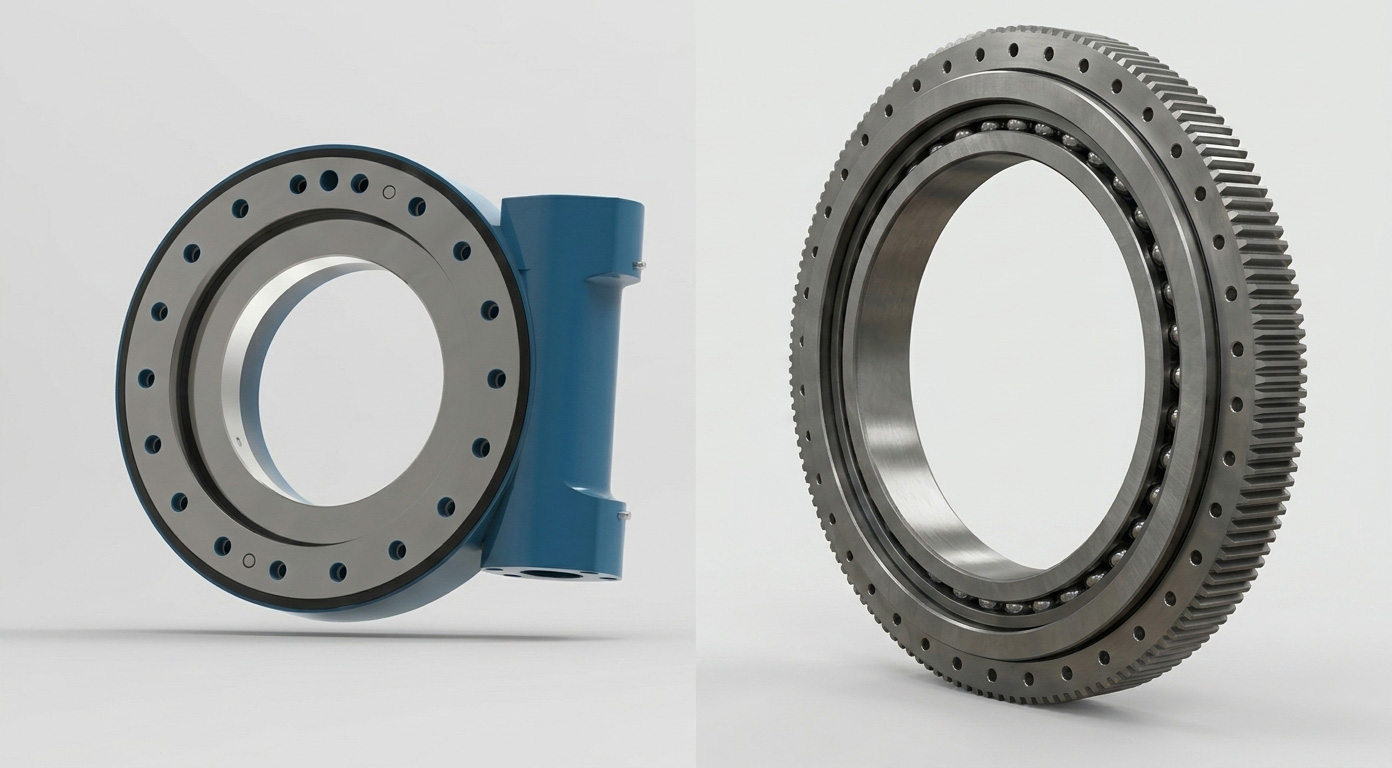
Slew Drive vs. Slewing Ring and Pinion: Which One Saves You More Money?
When designing a rotating platform—whether for a solar tracker, a crane, or an industrial turntable—engineers and procurement managers face a classic dilemma. Should you buy a fully integrated slew drive, or build your own solution using a separate slewing ring and pinion?
At first glance, the slewing ring and pinion appears cheaper. The individual components cost less, and the upfront price tag looks attractive. But is that the whole story?
LyraDrive engineers will take you through a comprehensive comparison of both solutions across five critical dimensions: structure, features, advantages, working principles, and real-world applications. More importantly, LyraDrive engineers willanalyze the 10-year total cost of ownership (TCO) to answer one question: which option actually saves you more money?
By the end, you will have a clear framework to make the right choice for your specific application.
What Is a Slew Drive?
A slew drive is a fully integrated, ready-to-install rotary actuation unit. It combines four essential components into a single compact housing:
A slewing ring bearing (with internal or external teeth)
A worm gear (or in some designs, a cycloidal or planetary gear)
A housing (typically cast or machined steel)
Integrated seals and lubrication
The input shaft connects directly to a motor or hydraulic motor. Once mounted, the slew drive provides controlled rotation of the attached load. No additional components are needed.
Slew drives are available in sizes ranging from 100 mm to over 2,000 mm in outer diameter. Torque capacities typically range from 500 Nm to 50,000 Nm, with tilt moment capacities reaching 1,000 kNm or more.
Think of a slew drive as a plug-and-play rotary joint. Bolt it down, connect a motor, and it is ready to work.
What Is a Slewing Ring and Pinion?
A slewing ring(also known as a slewing bearing) and pinion is a modular, build-it-yourself solution. Unlike an integrated slew drive, this approach requires the user to source, assemble, and seal the components separately.
The system consists of a slewing ring, which is a large-diameter bearing with internal or external gear teeth that handles axial loads, radial loads, and tilt moments but contains no drive mechanism. It also requires a pinion gear, which is a small gear mounted on the output shaft of a motor or gearbox that engages with the teeth of the slewing ring. Additionally, the user must supply components such as a motor, gearbox (if needed), mounting brackets, protective covers, and a lubrication system.
The slewing ring alone can range from 200 mm to over 5,000 mm in diameter. Pinion modules typically range from 4 to 25, depending on load and speed requirements.
Think of a slewing ring and pinion as a DIY computer. You buy the CPU, motherboard, graphics card, power supply, and case separately, then assemble them yourself. The flexibility is high, but so is the complexity.
Key Features of Slew Drive
A slew drive offers a highly integrated, single-unit design that arrives ready for installation. One of its most valuable features is inherent self-locking capability, as the worm design provides automatic back-drive prevention without any external brake. The unit comes factory-sealed to IP65 or IP66 standards, making it dust-tight and protected against jets of water. Backlash is factory preset and can be as low as one arcminute for precision models. Mounting is simple and bolt-on, requiring no specialized skills. Lubrication is factory-filled with lifetime or extended-interval grease. As a result, maintenance requirements are very low, typically limited to periodic visual inspection. Slew drives are generally available for diameters up to 2,000 mm and are designed for low-speed operation, usually at or below 10 rpm.
Key Features of Slewing Ring and Pinion
A slewing ring and pinion system has low integration, meaning the user must integrate all components from multiple sources. There is no inherent self-locking capability, so an external brake is required to hold position. Sealing must be designed by the user, which typically requires adding a protective cover or enclosure. Backlash is adjusted in the field and is highly dependent on the quality of installation. Mounting is complex and requires careful tooth alignment and backlash adjustment. Lubrication is user-defined, typically involving either manual or automatic re-greasing schedules. Consequently, maintenance requirements are higher, with regular re-lubrication and wear inspection needed. The diameter range is virtually unlimited and can exceed 10,000 mm. Speed range is flexible and can be designed for high-speed operation.
Advantages of Slew Drive
Slew drives offer several compelling advantages, especially when viewed through the lens of total cost of ownership.
Installation cost savings. A slew drive requires only four to eight mounting bolts and a motor connection. Installation typically takes one hour. Compare that to a full day of work for a slewing ring and pinion system.
No additional sealing or guarding. The integrated IP66 sealing system eliminates the need for protective covers or enclosures. That saves hundreds or even thousands of dollars.
No brake required. The worm gear's inherent self-locking property means you do not need an expensive brake motor. A standard motor works perfectly.
Minimized downtime. When a slew drive fails, you unbolt it and bolt on a replacement. Downtime is typically 30 minutes. For a slewing ring and pinion system, a failure often means days of disassembly, repair, and realignment.
Lowest maintenance cost. Factory-sealed, lifetime lubrication means no scheduled grease refills. No technician hours spent crawling under machinery to pump grease into fittings.
Reduced engineering risk. The manufacturer has already validated the assembly. There is no risk of mismatched components, incorrect backlash, or misaligned mounting.
Advantages of Slewing Ring and Pinion
Despite the advantages of slew drives, the slewing ring and pinion approach remains viable in specific scenarios.
Lower upfront purchase price. A basic slewing ring, a standard pinion, and an ordinary motor can cost 20 to 40 percent less than an equivalent slew drive. For extremely budget-constrained projects, this matters.
Very large diameters. Slew drives become prohibitively expensive above 2,000 mm diameter. A slewing ring and pinion system can be built for diameters of 5,000 mm or more without extreme cost premiums.
High-speed operation. Worm gear drives become inefficient and overheat above approximately 50 rpm. A geared pinion system can operate at much higher speeds with 98 percent efficiency.
Modular replacement. If only the pinion gear wears out, you replace only the pinion. If the seal fails, you replace only the seal. You do not need to scrap the entire assembly.
Extreme customization. Need a special tooth profile? An exotic corrosion-resistant coating? A slewing ring and pinion system allows unlimited customization.
How Does a Slew Drive Work?
The power flow in a slew drive follows a simple path: motor power goes to the input shaft, then to the worm gear, which engages with the internal ring gear, causing the housing to rotate and the load to turn.
The critical engineering principle is worm gear transmission. The worm has a very small helix angle, which creates high friction between the worm and the gear teeth. This friction prevents the load from back-driving the worm. The result is inherent self-locking.
In practice, this means that when the motor stops, the load stays exactly where it stopped. No brake, no holding torque, no drift.
Slew drives are designed for low-speed, high-torque applications. Typical speeds range from 0.1 to 10 rpm. Efficiency ranges from 70 to 85 percent for non-self-locking designs, and 40 to 60 percent for self-locking designs. The efficiency trade-off is the price of self-locking capability.
Precision comes from factory-matched grinding of the worm and ring gear. Backlash can be held to one arcminute or less, enabling highly accurate positioning.
How Does a Slewing Ring and Pinion Work?
The power flow in a slewing ring and pinion system is straightforward: motor power goes to a gearbox (if used), then to the pinion gear, which engages with the slewing ring gear teeth, causing the load to rotate.
Unlike a worm drive, there is no inherent self-locking. When the motor stops, the load can back-drive the pinion unless an external brake is applied.
The critical installation challenge is backlash adjustment. The pinion and slewing ring teeth must mesh with a precise clearance. Too little clearance causes binding, overheating, rapid wear, and eventual seizure. Too much clearance results in rattling, impact loads, poor positioning accuracy, and accelerated tooth wear.
Achieving correct backlash requires skilled technicians, dial indicators, and sometimes multiple adjustment attempts. The process can take several hours.
Once installed, the open gear mesh requires regular lubrication. Dust, dirt, and moisture can enter the mesh, accelerating wear. Many users install automatic grease systems to maintain proper lubrication, adding both upfront and ongoing costs.
The slewing ring and pinion system can operate at high speeds, limited only by the chosen lubrication method and gear design. Efficiency can reach 98 percent, significantly higher than a worm-based slew drive.
Applications of Slew Drive
Slew drives excel in applications that demand reliability, low maintenance, and self-locking capability.
Solar and photovoltaic trackers. Outdoor operation, no maintenance for years, and wind loads require self-locking. A slewing ring exposed to the elements would quickly rust and seize.
Mobile cranes and knuckle booms. Compact installation space, shock loads during operation, and the need for safety redundancy make slew drives the standard choice.
Radar and satellite communication antennas. Zero-backlash positioning and continuous tracking demand the precision of a factory-ground slew drive.
Aerial work platforms. Safety is paramount. The worm gear's self-locking provides a critical backup to the primary braking system.
Anti-drone systems and electro-optical turrets. Fast response, compact packaging, and outdoor protection are all inherent to slew drive design.
Automated welding positioners. Repeatable positioning accuracy and intermittent duty cycles match perfectly with slew drive characteristics.
Applications of Slewing Ring and Pinion
Slewing ring and pinion systems remain the preferred choice in several niche applications.
Large bulk handling stackers and reclaimers. Diameters of 5,000 to 15,000 mm are common. No slew drive manufacturer offers products in this size range.
Port container cranes. Massive dimensions and extremely low rotational speeds make the upfront cost advantage of a slewing ring and pinion system very attractive.
High-speed automated turntables. When production lines require continuous rotation above 50 rpm, a worm-based slew drive would overheat. A pinion-driven system handles the speed easily.
Low-cost demonstration or educational equipment. If the machine rotates only a few times per year and has no safety requirements, the cheapest possible solution may be acceptable.
Tunnel boring machine cutterhead drives. Multiple pinions driving a single enormous slewing ring distribute the massive torque required for rock cutting.
Extreme custom machinery. Need a slewing ring made of Inconel for high-temperature service? That is a job for a slewing ring and pinion system.
10-Year Total Cost of Ownership (TCO) Breakdown
The following TCO analysis is based on a typical medium-duty industrial application: a 1,500 mm diameter rotating platform, 10,000 Nm torque requirement, operating 8 hours per day, 5 days per week.
Initial purchase price. A slew drive typically costs $3,000, while a slewing ring and pinion system costs approximately $2,200.
Installation labor. Installing a slew drive takes about one hour at a cost of $200. A slewing ring and pinion system requires a full day of skilled labor, costing approximately $800.
Protective cover and enclosure. A slew drive has integrated sealing, so no additional cost. A slewing ring and pinion system typically requires a $500 protective cover.
Brake motor requirement. A slew drive is self-locking and uses a standard motor at no extra cost. A slewing ring and pinion system requires a $400 brake motor.
Automatic lubrication system. A slew drive has lifetime grease at no additional cost. A slewing ring and pinion system typically needs a $600 automatic lubrication system.
Annual maintenance labor. A slew drive requires only one hour of inspection per year at $100 annually. A slewing ring and pinion system requires one hour of maintenance per month at $600 annually.
10-year maintenance total. Over ten years, the slew drive totals $1,000 in maintenance costs. The slewing ring and pinion system totals $6,000.
Expected failure events over ten years. A slew drive experiences 0.5 failures on average. A slewing ring and pinion system experiences approximately 2 failures.
Downtime cost per event. Assuming a downtime cost of $5,000 per hour, the slew drive incurs $2,500 in downtime costs (0.5 × $5,000). The slewing ring and pinion system incurs $10,000 in downtime costs (2 × $5,000).
10-year total cost of ownership. The slew drive totals $6,700. The slewing ring and pinion system totals $20,500.
The slew drive delivers a 67 percent lower total cost of ownership over ten years. The initial purchase price advantage of the slewing ring and pinion system disappears completely when installation, maintenance, and downtime are included.
When Does Each Solution Really Save You Money?
Choose a slew drive when:
The equipment operates outdoors
The expected service life exceeds two years
Daily operation exceeds one hour
The diameter is less than 2,000 mm
Safety requires holding position without power
Skilled maintenance labor is expensive or unavailable
Downtime costs more than $500 per hour
Choose a slewing ring and pinion system only when all of the following are true:
The diameter exceeds 2,000 mm (or you need speeds above 50 rpm)
The equipment has a planned life of less than two years
Downtime cost is negligible
You have skilled technicians available for assembly and maintenance
The lower upfront purchase price is the only decision factor
For approximately 95 percent of industrial rotary applications, the slew drive delivers lower total cost. The slewing ring and pinion is a specialized solution for niche cases, not a general-purpose alternative.
LyraDrive: Custom Slew Drive and Slewing Bearing Manufacturer
LyraDrive specializes in engineered rotary motion solutions. Unlike catalog-only suppliers, LyraDrive offers custom-designed slew drives and slewing bearings tailored to specific application requirements.
Custom slew drives. LyraDrive engineers work directly with customers to specify the exact torque, tilt moment, backlash, speed, and environmental protection needed. Whether the application demands a low-profile design, extreme temperature operation, or special corrosion protection, LyraDrive delivers a purpose-built solution.
With worm slew drives, spur gear slew drives and worm gear drives, the LyraDrive includes a wide range of solutions for steering, turning and swiveling applications.
Custom slewing bearings. For customers who require a slewing ring and pinion configuration, LyraDrive provides high-quality custom slewing bearings. Sizes range from 200 mm to over 5,000 mm diameter. Tooth profiles, mounting hole patterns, seal configurations, and materials are all available to customer specifications.
Engineering support. LyraDrive provides application engineering support to help customers make the correct choice between integrated slew drives and separate slewing ring and pinion systems. A detailed TCO analysis is available upon request.
Just submit your requirement via email, and we will offer a design with 3D files.
Global shipping. LyraDrive serves customers worldwide with competitive lead times and responsive technical support.
For more information, visit LyraDrive's official website or contact their engineering team with your load, speed, and duty cycle specifications.
 WhatsApp
 sales@lyradrive.com
 +8613903880726