



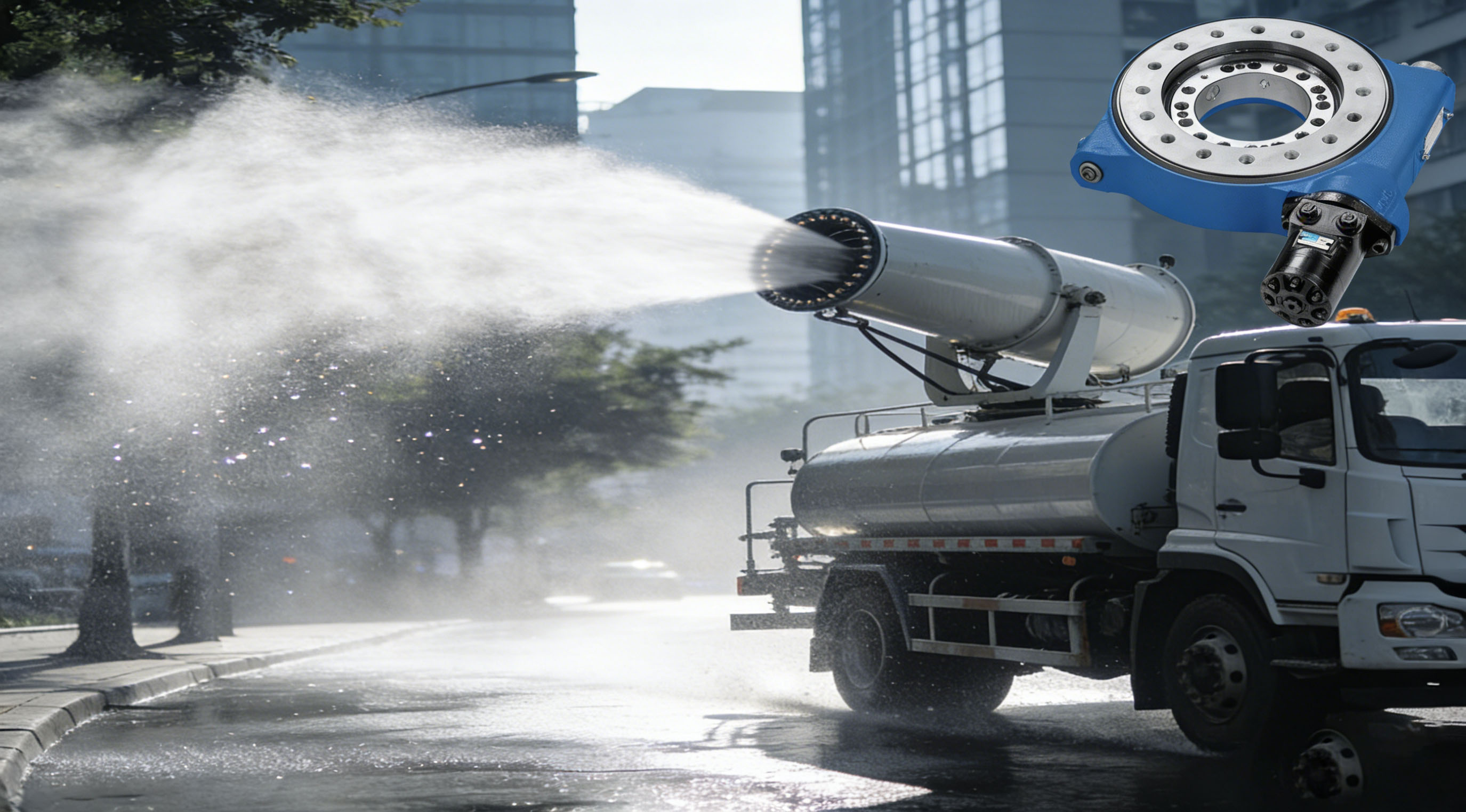
Slew Drive Application in Fog Cannon
What Is a Slew Drive?
A slew drive is a compact, high-performance rotational component that combines a worm gear, a bearing, and a housing into a single integrated unit. It is designed to transmit torque while supporting radial, axial, and tilting moment loads simultaneously. Slew drives are commonly available in single-axis configurations for horizontal rotation and dual-axis configurations for applications requiring both pan and tilt movements. Key characteristics include high torque density, smooth motion, self-locking capability, and the ability to operate reliably under heavy loads and harsh environmental conditions.
What Is a Fog Cannon?
A fog cannon, also known as a dust suppression cannon or mist sprayer, is a machine designed to project a fine mist of water or chemical solution over a wide area. It is widely used in applications such as mining, construction sites, demolition, waste management, and agricultural operations for dust control, cooling, and disinfection. The main components of a fog cannon include a high-velocity fan, a nozzle system, a water pump, and a rotation mechanism. The rotation mechanism is essential for achieving wide-area coverage and precise targeting, allowing the cannon to sweep horizontally across a defined working zone.
How a Slew Drive Works in a Fog Cannon?
The slew drive is integrated into the fog cannon’s base structure, serving as the core component of the horizontal rotation system. A motor—either electric or hydraulic—drives the worm gear inside the slew drive. The worm gear transmits torque to the output flange, which rotates the upper structure of the fog cannon. The self-locking characteristic of the worm gear system ensures that the cannon remains stable in its position even when subjected to external forces such as wind or the recoil from high-velocity air and water discharge. This allows for precise directional control without the need for an additional braking mechanism.
In terms of function, the slew drive serves three primary roles in a fog cannon: it provides smooth and controlled rotational motion, it maintains positional stability under dynamic loads, and it integrates load-bearing and rotation capabilities into a single compact unit, simplifying overall system design.
Features of Slew Drive for Fog Cannon Applications
Slew drives designed for fog cannon applications incorporate several key features that make them well-suited to the demands of this equipment:
Compact Design with High Torque Output: Despite their small footprint, slew drives deliver substantial torque, enabling smooth rotation even for large fog cannons.
Integrated Bearing: The built-in bearing supports radial, axial, and tilting moment loads simultaneously, eliminating the need for separate bearing components.
Robust Sealing: High-grade seals with IP ratings ensure protection against dust, water, and corrosive elements commonly encountered in outdoor and industrial environments.
High Positioning Accuracy: Precision manufacturing allows for accurate angle control, essential for targeted spraying operations.
Self-Locking Capability: The worm gear design inherently prevents back-driving, ensuring the cannon stays in position without additional braking devices.
Advantages of Using Slew Drive in Fog Cannon
The adoption of slew drives in fog cannon systems offers numerous advantages over traditional rotation mechanisms such as pinion-and-rack systems or separate gearbox and bearing assemblies:
Enhanced Reliability: By combining multiple functions into a single unit, slew drives reduce the number of components and potential failure points, resulting in higher overall system reliability.
Lower Maintenance: The sealed structure minimizes the ingress of contaminants and reduces lubrication requirements, leading to lower maintenance frequency and cost.
Precision Control: The inherent accuracy of the worm gear mechanism enables fine-tuned positioning, which is critical for applications requiring precise spray targeting.
Space and Cost Efficiency: Consolidating bearing, gearing, and housing into one unit reduces the overall footprint and simplifies assembly, lowering both material and labor costs.
Durability: Designed to withstand harsh operating conditions, slew drives offer long service life with consistent performance in dusty, wet, or temperature-variable environments.
How to Choose the Right Slew Drive for Fog Cannon Applications?
Selecting the appropriate slew drive for a fog cannon is a critical engineering decision that directly impacts equipment performance, operational safety, and long-term reliability. An undersized slew drive may lead to premature failure, excessive wear, or positional instability, while an oversized unit adds unnecessary cost and weight. The selection process should be systematic, taking into account mechanical loads, environmental conditions, integration requirements, and operational duty cycles.
Load Analysis
The most fundamental step in slew drive selection is determining the loads that the unit must support and transmit. A fog cannon imposes three types of loads on the slew drive:
Axial Load (Fa): The vertical load resulting from the weight of the cannon structure, including the fan assembly, nozzle system, and any attached components. This load acts downward through the slew drive’s axis.
Radial Load (Fr): The horizontal load acting perpendicular to the axis of rotation. This is typically caused by wind forces acting on the cannon’s profile, as well as inertial forces during acceleration and deceleration.
Tilting Moment Load (M): The overturning moment generated when the cannon’s center of gravity is offset from the slew drive’s rotational axis. This moment is particularly significant in fog cannons where the cannon arm extends horizontally from the pivot point.
These loads rarely act in isolation. The slew drive must simultaneously support axial, radial, and tilting moment loads, often with dynamic variations during operation. Manufacturers provide load capacity curves that define the permissible combinations of these loads. The selected slew drive must operate within these limits under all expected operating conditions, including worst-case wind scenarios and emergency stops.
Torque Calculation
Torque requirements determine whether the slew drive can reliably initiate, maintain, and halt rotation. Three torque values must be considered:
Starting Torque: The torque required to overcome static friction and inertia when beginning rotation from a standstill. This is typically the highest torque demand and is influenced by the cannon’s moment of inertia and any preload in the system.
Running Torque: The torque needed to maintain constant rotational speed. This is primarily determined by friction within the slew drive and any external resistance, such as wind drag.
Stopping Torque: The torque required to decelerate and hold the cannon in position. While the self-locking feature of worm gear slew drives provides holding capability, the drive system must still be capable of controlled deceleration.
The required torque can be calculated using the following basic relationship:
T=I×α+Tf+Tw
Where:
T = required torque (Nm)
I = moment of inertia of the rotating structure (kg·m²)
α = angular acceleration (rad/s²)
Tf = friction torque (Nm)
Tw = torque contribution from wind load (Nm)
For fog cannon applications, the moment of inertia is often significant due to the extended arm length. Accurate calculation requires detailed mass distribution data. In practice, many manufacturers rely on empirical data or provide selection software to assist with torque determination.
Duty Cycle and Operational Profile
The slew drive’s service life is directly influenced by how frequently and intensively it is operated. Key factors include:
Daily Operating Hours: Continuous operation imposes greater thermal and fatigue demands than intermittent use.
Rotation Frequency: The number of start-stop cycles per hour affects wear on the worm gear and bearings.
Rotation Angle: Full 360-degree rotation involves different load distributions than limited-arc oscillation.
Speed Requirements: Higher rotational speeds increase dynamic loads and frictional heat generation.
Slew drives are typically rated for a specific service life, often expressed in hours or cycles under defined load conditions. Matching the operational profile to the slew drive’s design life ensures reliable performance over the expected equipment lifespan.
Environmental Considerations
Fog cannons operate in diverse and often challenging environments. The slew drive’s construction must be compatible with:
Moisture and Humidity: Fog cannons generate significant water mist, and outdoor installations are exposed to rain. Sealing must prevent water ingress that could lead to corrosion or lubricant degradation. Ingress protection ratings such as IP65 or higher are typically recommended.
Dust and Particulates: Applications such as mining and construction involve high dust loads. Seals must effectively exclude abrasive particles that could accelerate wear.
Temperature Extremes: Operating temperature ranges affect lubricant viscosity, material properties, and seal flexibility. The slew drive should be specified with appropriate lubricants and materials for the expected ambient conditions.
Corrosive Agents: In certain applications, fog cannons disperse chemical solutions for disinfection or odor control. Exposure to these chemicals may require specialized coatings or corrosion-resistant materials.
Integration and Interface Compatibility
The slew drive must integrate seamlessly with the fog cannon’s mechanical structure and control system:
Mounting Interface: The slew drive’s mounting flange dimensions, bolt pattern, and overall height must match the fog cannon’s base structure. Custom interfaces are often required to accommodate existing designs.
Motor Integration: The slew drive may be supplied with a pre-mounted motor or designed to accept a specific motor type (electric or hydraulic). Motor mounting flange standards, shaft configurations, and coupling methods must be carefully coordinated.
Control System Compatibility: For automated or remotely operated fog cannons, the slew drive’s positioning feedback, limit switches, and drive electronics must be compatible with the overall control architecture.
Safety and Regulatory Requirements
Slew drives used in fog cannon applications must meet applicable safety standards and operational requirements:
Self-Locking Capability: The worm gear’s inherent self-locking feature prevents unintended rotation under load, eliminating the need for external brakes and enhancing safety during operation or power loss.
Hold Torque Verification: Even with self-locking, the hold torque rating should be verified against the maximum external forces expected to act on the cannon.
Structural Integrity: The slew drive’s housing and mounting flanges must withstand the structural loads imposed during normal operation and foreseeable overload conditions.
Selection Process Summary
A structured approach to slew drive selection typically follows these steps:
Define Operational Requirements: Compile complete specifications, including cannon weight, dimensions, center of gravity location, rotational speed, angle range, and environmental conditions.
Calculate Loads and Torque: Determine axial, radial, and moment loads under worst-case scenarios. Calculate starting, running, and stopping torque requirements.
Determine Duty Profile: Establish expected operating hours, cycle frequency, and speed variations.
Identify Environmental Factors: Assess sealing, temperature, and corrosion protection needs based on installation environment.
Select Preliminary Model: Using manufacturer load capacity charts and torque ratings, identify slew drive models that meet or exceed the calculated requirements.
Verify Integration Compatibility: Confirm mounting interface dimensions, motor compatibility, and control system integration.
Review Life Expectancy: Compare the calculated service life against project requirements. If necessary, upsize or select a heavier-duty series.
Consult Manufacturer: For critical applications or non-standard requirements, engage with the slew drive manufacturer to validate selection and discuss customization options.
Proper selection ensures that the slew drive delivers reliable, precise rotation throughout the fog cannon’s operational life, minimizing downtime and total cost of ownership.
LyraDrive: Supplier of rotary drives for fog cannon applications
Luoyang Slewing Bearing Co., Ltd. (LyraDrive) is a professional one-stop slewing device manufacturer majored in design and development, customized production, sales and service on slewing bearings and slewing drives. LyraDrive provides high quality and customized slew bearings, slew drives and gear rings for truck crane, excavator, manlift and other applications.
If you are looking for a slew drive supplier for your fog cannon application or need technical support, feel free to contact LyraDrive. We provide professional solutions tailored to your specific requirements, ensuring optimal performance and reliability for your equipment.
FAQ of Slew Drive for Fog Cannon Applications
Q1: What type of slew drive is best for fog cannon applications?
Typically, single-axis worm gear slew drives with self-locking capability are recommended for horizontal rotation control in fog cannons. For applications requiring both horizontal and vertical adjustment, dual-axis configurations are available.
Q2: How much torque do I need for my fog cannon?
Torque requirements depend on several factors, including the cannon’s size and weight, wind load exposure, rotational speed, and acceleration requirements. As detailed in Section 6.2, accurate torque calculation involves moment of inertia, angular acceleration, friction torque, and wind load contribution. LyraDrive can assist with torque calculation and selection based on your specific parameters.
Q3: Can the slew drive handle outdoor weather conditions?
Yes, slew drives designed for fog cannon applications feature high-grade sealing and corrosion-resistant coatings, ensuring reliable operation in dusty, rainy, and humid environments. Refer to Section 6.4 for detailed environmental considerations.
Q4: Does the slew drive require frequent maintenance?
No. The sealed design significantly reduces maintenance requirements. Periodic inspection and lubrication are recommended based on operating conditions, but the overall maintenance burden is substantially lower than conventional rotational systems.
Q5: Can LyraDrive provide customized solutions?
Yes, LyraDrive specializes in custom design and manufacturing. We can tailor slew drives to meet specific mounting interfaces, torque requirements, motor integration needs, and environmental protection levels.
Q6: What is the typical lifespan of a slew drive in fog cannon applications?
With proper selection, installation, and operation, slew drives offer a long service life. Under normal operating conditions, a well-maintained slew drive can exceed 10 years of reliable performance.
Q7: How do I get technical support or a quote?
Contact LyraDrive directly for technical support, selection assistance, and quotation. Our engineering team is available to help you find the optimal solution for your fog cannon application.
 WhatsApp
 sales@lyradrive.com
 +8613903880726