



What is a mobile crane slew drive? It is the transmission assembly that converts motor input into controlled rotation of a crane upper structure, boom platform, or slewing turntable. In most crane layouts, the drive must deliver enough torque to start, stop, hold, and position a suspended load while the bearing carries axial, radial, and overturning loads.
The main thermal question is not simply whether the drive can rotate the crane. It is whether it can repeat acceleration and braking cycles for the planned shift without producing more heat than it can release. A mobile crane slew drive may operate well during occasional positioning but overheat when the same machine performs frequent pick-and-place cycles, rapid reversals, or high-temperature work.
For OEM engineers and fleet operators, duty-cycle validation should therefore begin with the actual working pattern. Record the load condition, rotation angle, acceleration rate, deceleration method, dwell time, ambient temperature, motor type, gearbox ratio, and available airflow. A torque figure alone cannot establish whether the system will remain within its thermal capacity.
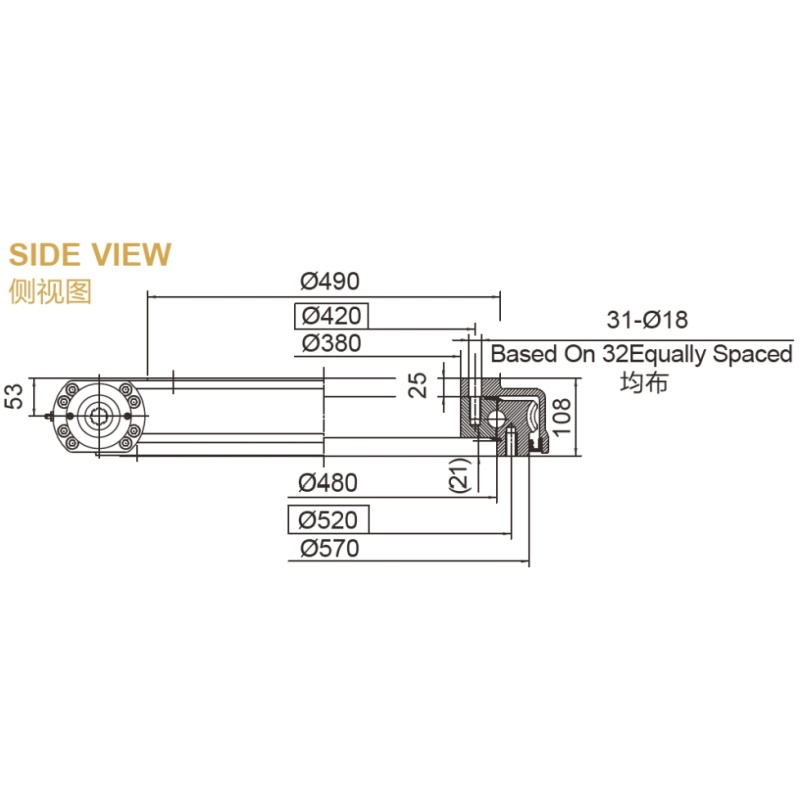
Heat generation starts with torque, speed, and repeated motion
A slewing transmission generates heat whenever mechanical losses convert input energy into friction. The main loss sources are gear meshing, worm sliding where a worm arrangement is used, rolling contact in the bearing system, lubricant churning, seals, and motor losses. The amount of heat rises when torque and speed rise together, but frequent starts and stops can be equally demanding.
For crane duty, acceleration is often the hidden heat source. Each time the upper structure begins to rotate, the drive must overcome static friction and accelerate the rotating mass. When the crane stops or reverses, braking energy also becomes heat in the drivetrain, brake, motor, or control system depending on the machine design.
The practical consequence is clear: a slow, steady rotation with long rest periods can be easier on a drive than a short, rapid swing repeated many times per hour. This is why an application described only as “intermittent crane rotation” is not detailed enough for technical approval.
| Operating attribute | What it changes | Practical effect on heat | When it matters most |
|---|---|---|---|
| Output torque | Gear and bearing contact forces | Higher friction loss under load | Heavy lifts, long boom radius, off-center loads |
| Rotational speed | Gear mesh frequency and lubricant movement | More heat generated per unit of time | Fast slewing and frequent positioning |
| Acceleration and deceleration | Peak torque demand | Short high-load events repeat heat cycles | Pick-and-place work and rapid reversals |
| Cycle frequency | Total operating time before cooling | Heat accumulates between cycles | Shift-based production work |
| Ambient temperature | Temperature difference between drive and air | Reduces the rate of heat rejection | Summer work, enclosed housings, desert sites |
| Mounting arrangement | Heat path to structure and surrounding air | Can improve or restrict cooling | Compact crane housings and covered turntables |
Worm-based units are often selected for compact torque transmission and holding behavior, but their sliding contact means efficiency and thermal behavior need attention under sustained duty. A Worm Gear Slew Drive should be evaluated using the complete rotation profile rather than a single peak-load event.
Do not assume that a larger reducer always solves the problem. A larger unit may provide more torque margin, yet the motor, brake, control settings, mounting structure, and airflow can still establish the thermal limit. The right choice is the drive system whose torque capacity and heat balance both fit the working cycle.
Boundary analysis showing when repeated acceleration, high ambient temperature, and insufficient cooling exceed thermal capacity
Thermal capacity is exceeded when the average heat produced over a working period is greater than the heat the assembly can release to its surroundings. The drive temperature then continues to rise instead of stabilizing. This can change lubricant behavior, accelerate seal wear, affect gear contact conditions, and shorten component life.
The boundary is best understood as an interaction of three conditions. Repeated acceleration raises heat input. High ambient temperature reduces heat rejection. Insufficient cooling prevents accumulated heat from leaving the gearbox and surrounding structure fast enough. One condition may be acceptable alone, while all three together can create an unacceptable duty cycle.
| Condition | What happens mechanically | What to check | Limit of the recommendation |
|---|---|---|---|
| Repeated acceleration | Peak torque occurs again and again before the drive can cool. | Count starts, stops, reversals, swing angle, and loaded versus unloaded cycles. | Low-frequency repositioning may not create significant heat accumulation. |
| High ambient temperature | The temperature difference between the housing and air becomes smaller. | Use the highest expected air temperature near the installed drive, not a weather-station average. | Ambient temperature alone does not define performance if duty is light and cooling paths are open. |
| Insufficient cooling | Heat remains in the housing, mounting plate, and enclosed crane structure. | Inspect covers, airflow, nearby heat sources, and the thermal path into the crane frame. | An open installation may cool well, but contamination and corrosion requirements must still be met. |
| All three conditions combined | Heat input rises while heat rejection falls. | Request a duty-cycle review based on the actual crane motion profile. | A paper review should be confirmed by machine-level temperature monitoring during validation. |
A useful field distinction is between peak temperature and stable operating temperature. A brief peak during a single heavy swing may be acceptable if the system has enough dwell time to cool. A lower but continuously rising temperature during repeated cycles is more concerning because it indicates that the heat balance has not stabilized.
Consider a crane that rotates through a short angle, stops to place a load, then reverses to collect the next load. The total rotation angle may appear small. Yet the drive sees repeated acceleration, braking, and reversal torque, which can create more thermal stress than one long, slow rotation at similar average output speed.
High ambient temperature changes the same pattern further. If the drive operates inside a covered turntable compartment, radiant heat from nearby equipment and restricted airflow can raise the local air temperature beyond general site conditions. Design validation should use the temperature near the gearbox, not only the published outdoor maximum.
For applications with frequent reversing motion or high holding demand, a Double Worm Slew Drive can be considered where the mechanical layout and duty requirement support it. However, using two worms is not an automatic thermal answer. The full drive arrangement still requires review of motor input, control behavior, lubrication, and cooling conditions.
Request Your Custom Slew Drive or Bearing Spec
Tell us your load, speed, and environment — receive a tailored 100–5000 mm slewing drive or slewing bearing proposal with 3D drawings within 24 hours.
Build a duty-cycle record before selecting or approving the drive
The fastest way to avoid a poor thermal decision is to convert the crane’s work pattern into a repeatable duty-cycle record. This gives the drive supplier, OEM engineering team, and fleet maintenance group the same design basis. It also prevents a nominal torque comparison from replacing real application analysis.
- Define the moving mass. Identify the rotating upper structure, boom configuration, hook block condition, attachment mass, and expected suspended-load range.
- Map each motion event. Record the swing angle, direction, desired speed, acceleration time, deceleration time, and dwell time for each part of the operating cycle.
- Separate loaded and unloaded movements. A return swing may have lower static load, but fast acceleration and reversal can still create meaningful heat.
- Count cycles by the busiest work period. Use the most demanding expected hour or shift segment rather than an average day that includes idle time.
- Identify environmental limits. Include ambient temperature, rain exposure, dust, salt exposure, enclosure design, and available airflow.
- Review motor and braking settings. Abrupt acceleration, aggressive deceleration, and repeated direction changes may increase heat even when average speed remains low.
- Plan a monitored trial. Measure temperature trends during a representative duty period and compare the result with the approved operating assumptions.
This procedure fits both new equipment development and fleet retrofits. It does not replace structural calculations for the crane, slewing bearing selection, or safety-system design. Those checks remain separate because the drive transmits motion while the wider crane system manages load support, stability, braking, and operational safety.
When the drive and bearing are specified separately, confirm the interface early. Bolt pattern, mounting stiffness, gear engagement, load transfer, and lubrication access all influence final behavior. The matching Slewing Bearing must be selected for the crane’s axial, radial, and overturning load condition rather than treated as a generic turntable component.
Common duty-cycle mistakes that produce misleading thermal results
Many heat problems begin with a valid data point used in the wrong way. Peak output torque, maximum rotational speed, and static holding capacity describe different conditions. They should not be combined into one assumed operating point unless the manufacturer has assessed that exact combination.
- Using peak torque as a continuous-duty rating. Peak torque can describe short-duration capability, while continuous operation depends on heat dissipation. Use a time-based load profile instead.
- Ignoring acceleration torque. A crane may lift modest loads but still impose high transient torque when the operator commands fast starts or reversals. Include motion-control settings in the review.
- Using average ambient temperature. The drive experiences local temperature around the crane structure. Evaluate the hottest realistic installation condition.
- Assuming idle time always cools the unit. Short dwell periods may not remove much heat, especially in a covered or low-airflow enclosure. Check whether the temperature trend actually declines.
- Changing grease, seals, or motor controls after approval. Such changes can alter friction, protection, or heat input. Reassess the duty cycle if the installed configuration differs from the validated one.
- Specifying only the slew drive. The motor, gearbox, brake, bearing, mounting plate, and control system work as one thermal system. A component-only review can miss the limiting part.
A useful verification request should include the required output torque range, peak and normal speed, number of starts and reversals, expected ambient temperature, installation orientation, protection requirement, and cooling conditions. If any of these are unknown, the correct answer is not to assume a generous limit. The correct answer is to mark the assumption and validate it before deployment.
Luoyang Slewring Bearing Co., Ltd. can support this process with a technical proposal within 24 hours when the operating data is available. Our engineering team works with standard and custom configurations, while customized product orders start from five sets and standard product orders can start from one set for evaluation.
Choose the validation route that matches crane risk and operating intensity
For low-frequency crane positioning, a documented application review may be sufficient when the load, environment, and motion pattern are well defined. This approach fits equipment that slews occasionally, has long dwell periods, and operates in moderate ambient conditions. It does not fit a high-cycle production crane where the duty pattern changes throughout the shift.
For repeated handling work, combine the paper review with a monitored machine trial. Run the crane through the most demanding expected cycle, including loaded rotations and reversals, then observe whether temperature stabilizes or continues to rise. This method is especially useful when compact installation space restricts cooling or when the equipment will work in hot outdoor conditions.
| Application condition | Recommended validation level | Reason | When more testing is needed |
|---|---|---|---|
| Occasional positioning with long dwell periods | Duty-cycle data review | Heat has time to dissipate between movements. | Use a monitored trial if ambient temperature or load changes substantially. |
| Regular lift-and-swing work | Data review plus representative machine trial | Repeated starts and stops can accumulate heat. | Extend testing if operators use faster motion settings than planned. |
| High-cycle pick-and-place operation | Detailed cycle analysis plus temperature monitoring | Frequent acceleration and braking dominate thermal behavior. | Revalidate after changes to motor, controls, enclosure, or payload. |
| Hot, enclosed, or low-airflow installation | Detailed thermal review and monitored trial | Cooling may be the limiting condition. | Review again if protective covers or adjacent equipment are added. |
Quality evidence also matters when the drive will operate under heavy cyclic loads. Luoyang Slewring Bearing Co., Ltd. operates an ISO 9001:2015 certified quality management system, and every slewing bearing passes CMM three-coordinate inspection and dynamic load testing according to our stated quality process. Buyers can review our Slew Drive Quality Control approach when preparing supplier qualification documents.
Material and protection choices should follow the work environment, not a default catalog preference. Our drives can use ductile cast iron, alloy steel, stainless steel, or forged alloy steel according to load, speed, and environmental requirements. Protection can reach IP66 and anti-corrosion performance can reach C4H where the application requires it, but these features should be specified against actual exposure conditions.
Real crane-related supply cases show why the operating context must remain specific. A South Korean port equipment manufacturer placed a repeat order for 20 WEA9-62-25HR single worm units for port crane systems, specified with IP65 sealing, self-locking behavior, and tracking precision of no more than 0.15 degrees. In another case, a Netherlands material-handling equipment manufacturer ordered 50 WEA9-62-25HR units for truck-mounted loader cranes. These cases support the relevance of application-specific selection; they do not establish one universal heat limit for every crane.
Before release to production, confirm the crane’s busiest operating cycle, thermal environment, cooling path, drive interface, and test method. Where standard models do not fit the mounting geometry or duty profile, a Customized Slew Drive review can align the transmission arrangement with the machine design. Luoyang Slewring Bearing Co., Ltd. provides a two-year extended quality warranty and a 48-hour technical response for confirmed support needs.
Request Your Custom Slew Drive or Bearing Spec
Tell us your load, speed, and environment — receive a tailored 100–5000 mm slewing drive or slewing bearing proposal with 3D drawings within 24 hours.
 WhatsApp

 +8613903880726