



How to Choose Slewing Ring Bearing with External Gear?
What Is Slewing Ring Bearing with External Gear?
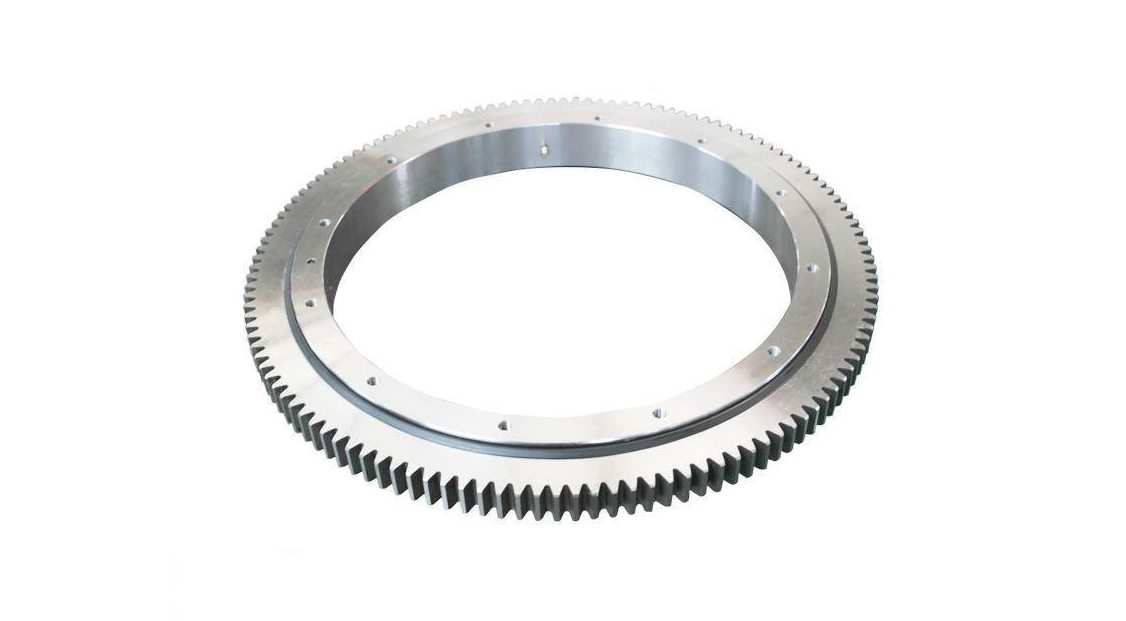
A slewing ring bearing with external gear, often referred to simply as a “slewing bearing” or “turntable bearing,” is a type of large-diameter bearing that integrates a gear tooth profile on the outer ring’s circumference. This design allows the bearing to function as both a rotational support element and a driven component. The external gear meshes with a driving pinion to transmit torque, enabling precise rotation of heavy structures such as crane turntables, excavator platforms, or solar tracking systems.
Internally, these bearings contain rolling elements (balls or rollers) arranged between inner and outer rings, with raceways designed to support combined loads: axial forces, radial forces, and tilting moments. The external gear configuration is one of the most common variants in heavy machinery applications due to its ease of integration and maintenance.
External Gear vs. Internal Gear: Key Differences
When selecting a slewing ring bearing, one fundamental decision is whether to choose an external gear or internal gear configuration. Both serve the same primary function but differ significantly in layout, installation, and application fit.
The table below summarizes the key distinctions:
| Comparison Aspect | External Gear Slewing Ring | Internal Gear Slewing Ring |
|---|---|---|
| Gear Location | Gear teeth on outer ring circumference | Gear teeth on inner ring circumference |
| Drive Layout | Pinion gear located outside the bearing | Pinion gear located inside the bearing |
| Installation Space | Requires external space for pinion; leaves inner bore unobstructed | Requires internal space for pinion; outer profile is compact |
| Maintenance Access | Gear teeth are fully visible and accessible for inspection, cleaning, and lubrication | Gear teeth are enclosed within the structure, making inspection and maintenance more difficult |
| Typical Applications | Tower cranes, stacker reclaimers, excavators, solar trackers | Mobile cranes, aerial platforms, wind turbines, industrial turntables |
| Cost Consideration | Generally lower manufacturing complexity for the mating structure | Often requires more precise housing alignment; can increase structural cost |
Choosing between the two largely depends on whether you need a clear inner bore for routing cables, pipes, or other components (favoring external gear) or a compact outer profile to fit within tight spaces (favoring internal gear).
Advantages of Slewing Ring Bearing with External Gear
Opting for a slewing ring bearing with external gear offers several practical benefits:
Simplified Maintenance: Since the gear teeth are exposed on the outer ring, they can be easily inspected, cleaned, and re-lubricated without disassembling surrounding structures. This reduces downtime and lowers long-term maintenance costs.
Unobstructed Inner Bore: The inner ring remains free of gear teeth, providing a large, open center passage. This is critical for applications that require routing hydraulic lines, electrical cables, or mechanical shafts through the center.
Multiple Drive Capability: External gear rings can be driven by two or more pinions simultaneously. This distributes torque load and provides redundancy, which is especially valuable in large-diameter, high-reliability equipment such as radar antennas or large cranes.
Ease of Installation: The mating structure (usually the rotating part) bolts directly to the outer ring without requiring precise internal gear alignment. Field replacement is also simpler compared to internal gear units.
Good Load Distribution: The external gear configuration allows the gear teeth to be positioned close to the bearing’s rolling elements, minimizing additional bending moments on the structure.
Typical Applications of Slewing Ring Bearing with External Gear
Slewing ring bearings with external gears are found across industries where heavy loads and rotational accuracy are required. Common application areas include:
Construction and Lifting Equipment: Tower cranes, mobile cranes, concrete pumps, and excavators use external gear slewing rings to enable smooth rotation of the upper structure against the undercarriage.
Material Handling: Stacker reclaimers, ship unloaders, and port cranes rely on large-diameter external gear bearings to support long booms and handle heavy loads under continuous duty cycles.
Renewable Energy: Solar tracking systems, particularly dual-axis trackers, often employ external gear slewing rings because the open inner bore allows cabling to pass through while the gear system drives precise sun tracking.
Industrial Machinery: Rotary tables, welding positioners, and medical imaging equipment (such as large CT scanners) benefit from the compact drive arrangement and unobstructed center opening.
Mining and Aggregate Equipment: Crushers, screens, and stackers operate in harsh environments where external gear rings offer better accessibility for cleaning and lubrication compared to internal gear alternatives.
Cost Considerations for Slewing Ring Bearing with External Gear
When budgeting for a slewing ring bearing with external gear, it is important to understand what drives the final price. Costs vary significantly based on specifications rather than a single fixed price range.
The primary cost factors include:
| Cost Driver | Impact on Price |
|---|---|
| Material Grade | Higher strength materials such as 42CrMo4 (compared to standard 50Mn) increase raw material cost but provide better fatigue life for demanding applications. |
| Gear Heat Treatment | Induction hardening or through-hardening of gear teeth adds processing cost but is essential for wear resistance in high-cycle or high-load applications. |
| Precision Level | Precision grades (e.g., P5, P4) require tighter manufacturing tolerances, additional grinding operations, and 100% dimensional inspection, raising cost significantly compared to standard engineering grades. |
| Sealing Configuration | Heavy-duty sealing systems with multiple lips or labyrinth designs increase cost but extend service life in dusty or wet environments. |
| Certification Requirements | Third-party inspections, material certificates (EN 10204 3.1/3.2), or classification society approvals (e.g., ABS, DNV) add documentation and testing costs. |
| Quantity and Customization | Non-standard bolt patterns, special gear modifications, or low-volume orders typically carry higher per-unit pricing due to setup and engineering overhead. |
As a rough guideline, for a typical 1-meter diameter external gear slewing ring in standard engineering grade, prices may start in the mid-hundreds to low thousands of USD. However, doubling the diameter or moving to precision grades can increase the cost by several multiples. The most accurate way to budget is to provide your load specifications, gear requirements, and mounting interface details to obtain a custom quotation.
Key Considerations for Selecting a Slewing Ring Bearing with External Gear
Choosing the correct slewing ring bearing with external gear requires evaluating several technical parameters. This section focuses on how to match the bearing to your application’s mechanical demands.
1. Load Capacity
The bearing must support three load types simultaneously: axial load (force parallel to the axis of rotation), radial load (force perpendicular to the axis), and tilting moment (bending force that tries to tip the rotating structure). Manufacturers provide static and dynamic load curves. Always select based on the most demanding load case, applying an appropriate safety factor (typically 1.25 to 1.5 for static loads, higher for dynamic or shock-loaded applications).
2. Gear Specifications
The external gear is defined by:
Module: Determines tooth size. Larger modules handle higher loads but reduce tooth count for a given diameter.
Number of Teeth: Affects rotational resolution and compatibility with the driving pinion.
Tooth Profile and Accuracy: Common standards include DIN 3962 or AGMA classes. Higher accuracy ensures smoother engagement and reduced backlash.
Surface Hardness: For applications with frequent rotation under load, gear teeth should be induction hardened (typically 50–55 HRC) to resist wear.
3. Dimensions and Mounting Interface
The bearing’s outer diameter, inner diameter, and height must fit your structural envelope. Critical mounting details include:
Bolt circle diameter: Both inner and outer ring bolt patterns must align with your structure.
Bolt size and grade: Use recommended high-strength bolts (e.g., Grade 10.9 or 12.9) and follow torque specifications.
Pilot fit: A machined pilot shoulder helps center the bearing and prevents shear loads on mounting bolts.
4. Operating Environment
Consider:
Temperature range: Standard bearings operate from -25°C to +80°C. Low-temperature or high-temperature greases and seals may be required for extreme environments.
Contaminants: Dust, water, or abrasive particles demand robust seals (e.g., double lip or labyrinth) and possibly additional protective covers.
Corrosive conditions: Marine or chemical environments may require surface treatments such as zinc phosphate coating or stainless steel raceways.
5. Drive Matching
The driving pinion must be compatible with the external gear in terms of module, pressure angle, and backlash. Ensure that the pinion’s material and heat treatment are appropriate for the duty cycle. For large-diameter applications, using two or more pinions can reduce individual tooth loads and provide redundancy.
6. Lubrication and Sealing
Proper lubrication is critical. Most slewing rings use NLGI No. 2 lithium-based grease. Specify grease type based on operating temperature and speed. Seals should be inspected regularly and replaced if damaged to prevent lubricant loss and contamination ingress.
7. Precision Level
Choose precision according to your application:
Standard grade (engineering): Suitable for construction, mining, and material handling where smooth rotation is sufficient.
Precision grade: Required for applications demanding low runout and high positioning accuracy, such as radar antennas, medical equipment, or precision rotary tables.
By systematically evaluating these parameters, you can narrow down the appropriate bearing specification before consulting a supplier.
LyraDrive: Supplier of High-Quality Slewing Ring Bearing with External Gear
At LyraDrive, we specialize in the design and manufacture of both slew drives and slewing bearings. Our expertise lies in delivering reliable rotation solutions for applications ranging from heavy construction equipment to precision industrial machinery. With a focus on quality and durability, we ensure every slewing ring bearing with external gear meets stringent performance standards.
We offer a complete range of slewing bearings to suit diverse load and precision requirements, including Single Row Slewing Ring Ball Bearings, Double Row Ball Slewing Ring Bearings, Three-row Roller Slewing Bearings, and Crossed Roller Slewing Bearings. Whether you need a standard configuration or a fully customized solution with specific gear modifications, mounting interfaces, or special materials, LyraDrive provides engineering support and manufacturing capabilities to deliver the right bearing for your application.
FAQs About Slewing Ring Bearing with External Gear Selection
Q1: Can a slewing ring bearing with external gear be used for reverse drive?
Yes. The external gear can be driven in both directions. However, if the load may back-drive the system (e.g., in a wind turbine or inclined solar tracker), you should incorporate a braking mechanism or self-locking drive to prevent unintended rotation.
Q2: What is the difference between a slewing ring bearing with external gear and a slew drive?
A slewing ring bearing with external gear is the bearing component itself, providing rotation support and a gear interface. A slew drive is a complete assembly that includes a slewing ring, a housing, a worm gear or pinion, and often a hydraulic motor or electric drive. Slew drives offer a more integrated, ready-to-install rotation solution.
Q3: How do I inspect and maintain an external gear slewing ring?
Regularly inspect gear teeth for pitting, wear, or debris. Check seals for damage or leakage. Re-lubricate through the provided grease fittings at intervals recommended by the manufacturer—typically every few hundred operating hours in heavy-duty applications. Retorque mounting bolts according to the specified schedule.
Q4: Can I replace only the gear on a slewing ring bearing with external gear?
Generally, the gear is integral to the outer ring. If the gear teeth are worn beyond acceptable limits, the entire bearing is usually replaced. Some high-end designs may offer replaceable gear inserts, but this is not common for standard slewing rings.
Q5: What is the typical lead time for a custom slewing ring bearing with external gear?
Lead times vary based on size, complexity, and current production schedules. Standard sizes may ship within a few weeks, while custom bearings with special materials, non-standard gears, or precision grades typically require 8 to 12 weeks. Contact LyraDrive with your specifications for a project-specific timeline.
 WhatsApp
 sales@lyradrive.com
 +8613903880726