



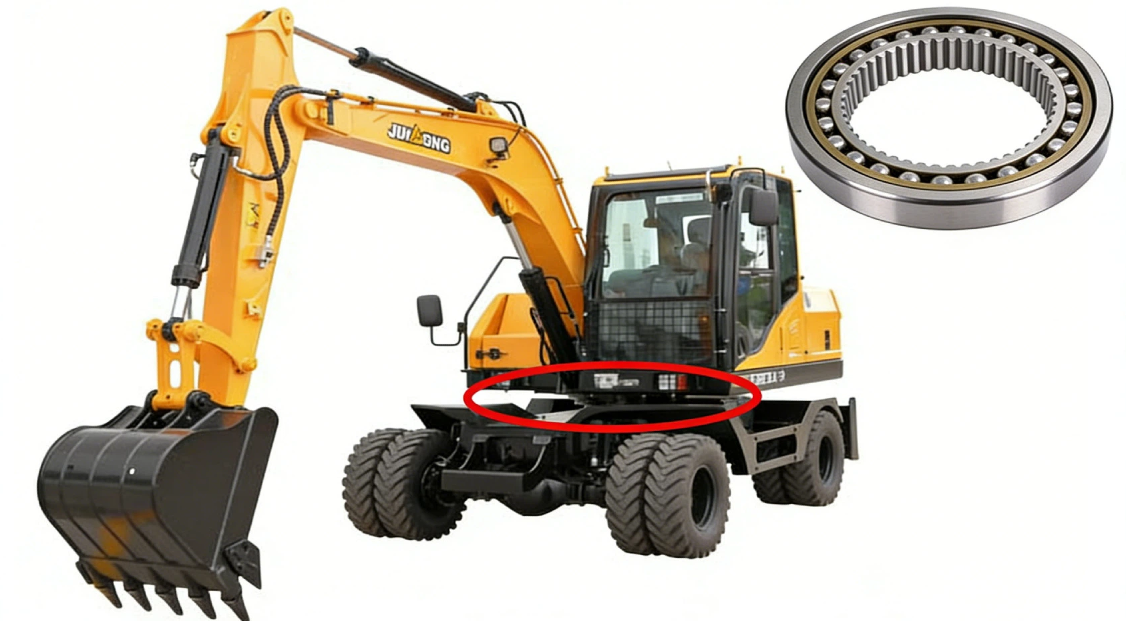
How to Choose a Slewing Bearing for an Excavator?
The slewing bearing is a critical component in an excavator, serving as the connection point between the upper structure (cab, arm, and bucket) and the undercarriage. It must withstand heavy loads, continuous rotation, and harsh working conditions, making the right selection essential for machine performance and longevity.
What Is an Excavator Slewing Bearing?
An excavator slewing bearing is a large-diameter, heavy-duty bearing that enables the upper structure of the machine to rotate smoothly relative to the undercarriage. It supports the full weight of the excavator’s upper structure while handling radial, axial, and tilting moment loads during digging, lifting, and swinging operations. Designed for durability, it integrates rolling elements (balls or rollers), rings, and often internal or external gearing to transmit rotational motion.
How an Excavator Slewing Bearing Works
The slewing bearing operates by allowing the upper ring to rotate against the lower ring via rolling elements between them. The outer or inner ring typically features gear teeth that mesh with a pinion driven by the excavator’s swing motor. As the motor turns, the gear rotates the bearing, enabling the cab and arm to swing left or right. Meanwhile, the bearing absorbs all operational forces—vertical loads from the weight of the structure, horizontal forces from digging, and tilting moments from the extended arm—ensuring stable and precise movement.
Key Features of an Excavator Slewing Bearing
Excavator slewing bearings are designed to meet the demands of heavy machinery. Key features include:
High Load Capacity: Engineered to support combined loads (axial, radial, and tilting moment) simultaneously.
Integrated Gearing: Often equipped with internal or external gear teeth for direct drive engagement.
Durable Materials: Manufactured from high-strength steel with heat-treated raceways for wear resistance.
Sealing Systems: Robust seals protect the rolling elements from contaminants like dust, mud, and water common on job sites.
Bolt Holes: Precision-drilled mounting holes allow secure attachment to both the upper and lower structures.
Key Types of Excavator Slewing Bearings
Selecting the right type is the first step in proper sizing. The most common types for excavators include:
Single Row Ball Slewing Bearings: A cost-effective solution for light to medium-duty excavators. They consist of a single row of balls and are suitable for applications with moderate loads.
Double Row Ball Slewing Bearings: With two rows of balls arranged at different angles, these bearings provide higher load capacity and greater stability, ideal for mid-sized excavators.
Three-Row Roller Slewing Bearings: Offering the highest load capacity, these bearings feature three separate rows of rollers—one for axial loads, one for radial loads, and one for tilting moment. They are commonly used in large excavators.
Crossed Roller Slewing Bearings: Cylindrical rollers are arranged in a crossed pattern, providing excellent rigidity and precision. They are well-suited for applications requiring smooth rotation and compact design.
How to Choose the Right Excavator Slewing Bearing
This is the core of the selection process. To choose the correct bearing, you need to evaluate several key factors based on your excavator’s specifications and operating conditions.
1. Determine the Load Requirements
Calculate the maximum loads the bearing will experience during operation. This includes:
Axial Load (Fa): The vertical load from the weight of the upper structure and digging forces.
Radial Load (Fr): Horizontal forces, such as when the excavator is on an incline or during sudden stops.
Tilting Moment (M): The overturning force caused by the arm and bucket extending outward.
These three loads act simultaneously and must be considered together. Most manufacturers provide static and dynamic load curves to help match the bearing to your machine.
2. Consider the Operating Environment
Excavators work in harsh conditions—mud, dust, rain, and extreme temperatures. Choose a bearing with appropriate seals (e.g., heavy-duty rubber or felt) to prevent contamination. For applications with frequent washing or exposure to corrosive materials, consider bearings with anti-corrosion coatings.
3. Select the Gear Configuration
Determine whether the excavator requires an internal gear, external gear, or no gear (if rotation is driven by other means). Check the gear module, number of teeth, and pressure angle to ensure compatibility with the excavator’s swing motor pinion.
4. Match the Mounting Dimensions
The bearing’s bolt circle diameter, bolt hole size, and ring cross-section must align with the mounting surfaces on the excavator’s upper and lower structures. Accurate measurement is crucial to avoid fitment issues.
5. Review the Rotation Speed
Excavator slewing bearings typically operate at low speeds (under 10 rpm). Confirm that the selected bearing’s dynamic load rating and grease type support the expected rotation frequency and duty cycle.
6. Factor in Service Life
Use the bearing’s basic rating life (L10) as a guide. This represents the number of revolutions or operating hours that 90% of bearings in identical conditions will achieve before fatigue. For excavators, a minimum service life of 5,000 to 10,000 hours is typical, but this may vary by application.
By systematically evaluating these factors, you can narrow down the bearing type, size, and configuration that will deliver reliable performance in your excavator.
Selection Errors to Avoid
Even experienced buyers can make mistakes. Here are common pitfalls and how to avoid them:
Underestimating the Tilting Moment: Focusing only on axial or radial loads while ignoring the overturning moment is a frequent error. This can lead to premature bearing failure. Always use combined load calculations.
Choosing the Wrong Gear Type: Selecting an internal gear when the excavator is designed for an external gear (or vice versa) results in incompatibility. Double-check the swing motor’s pinion location and the gear orientation.
Ignoring Seal Quality: Standard seals may not withstand heavy mud or water exposure. For excavators used in wet or abrasive conditions, upgrade to heavy-duty seals to extend bearing life.
Overlooking Bolt Selection: Using bolts that are too weak or improperly torqued can cause the bearing to loosen or the mounting surface to fail. Always follow the manufacturer’s recommendations for bolt grade and torque.
Neglecting Operating Temperature: Extreme cold can thicken grease and increase drag, while high temperatures can degrade lubricants. Choose a grease type suitable for the expected temperature range.
LyraDrive: Supplier of High-Quality Excavator Slewing Bearings
As a manufacturer specializing in slew drives and slewing bearings, LyraDrive is committed to providing reliable power transmission solutions for heavy machinery. Our slewing bearing product line includes Single Row Slewing Ring Ball Bearings, Double Row Ball Slewing Ring Bearings, Three-Row Roller Slewing Bearings, and Crossed Roller Slewing Bearings. Each type is engineered to deliver the strength, precision, and durability required in demanding excavator applications.
In addition to our standard offerings, we provide customized services to meet unique customer needs. Whether you require specific gear configurations, specialized seals, or non-standard mounting dimensions, we can tailor our slewing bearings to fit your excavator perfectly. With a focus on quality and performance, LyraDrive is a trusted partner for high-quality excavator slewing bearings.
FAQ of Selecting a Right Slewing Bearing
Q1: What is the most important factor when selecting a slewing bearing for an excavator?
The most critical factor is accurately calculating the combined loads—especially the tilting moment—because excavators experience high overturning forces during operation. Matching the bearing’s static and dynamic load ratings to your machine’s maximum working conditions is essential.
Q2: How do I know whether to choose a single row, double row, or three-row bearing?
This depends on the excavator size and load demands. Single row ball bearings suit light to medium excavators; double row ball bearings provide higher stability for mid-size machines; three-row roller bearings are for large excavators with extreme load requirements. Crossed roller bearings are a good choice when high rigidity and precision are needed.
Q3: Can I replace a slewing bearing with a different brand or type?
Yes, but you must ensure the new bearing matches the original in key dimensions: bolt circle diameter, ring cross-section, gear type, module, and number of teeth. Load capacity should be at least equal to the original. If you are unsure, consulting with a manufacturer like LyraDrive can help identify a compatible solution.
Q4: How often should an excavator slewing bearing be greased?
Greasing intervals depend on usage intensity and operating conditions. For excavators in heavy-duty applications, weekly greasing is common. For lighter use, monthly may be sufficient. Always follow the machine manufacturer’s recommended schedule and use a high-quality extreme-pressure grease.
Q5: What are signs that a slewing bearing is failing?
Common indicators include unusual noise (grinding or clicking), rough or jerky rotation, visible play between the upper and lower structure, grease leakage, and bolt loosening. If any of these occur, inspect the bearing promptly to avoid further damage or safety risks.
 WhatsApp
 sales@lyradrive.com
 +8613903880726