



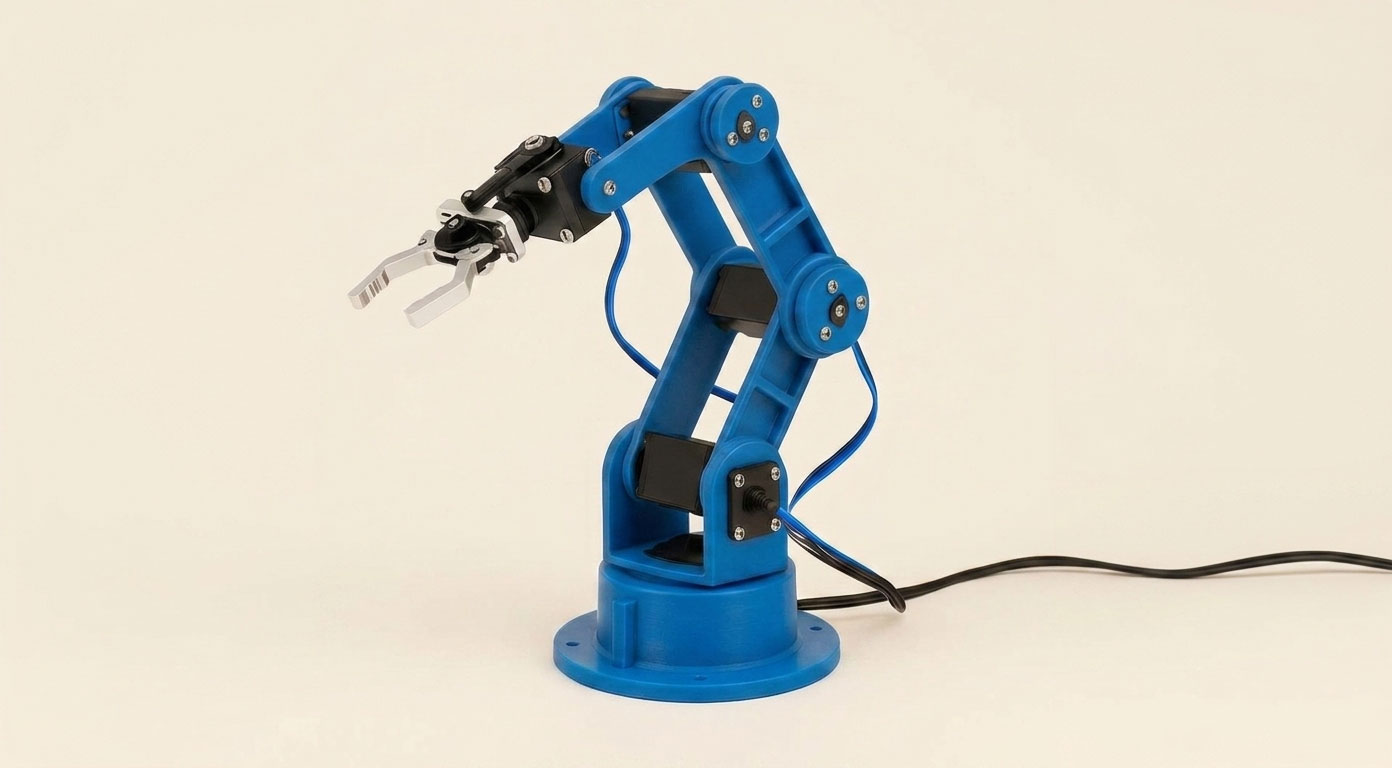
A Spur Gear Slew Drive for Robot Arm Base
What is a spur gear slew drive for Robot Arm Base?
A spur gear slew drive is a compact, high-load rotating device that uses straight-cut spur gears to transmit torque and enable slewing motion. In the context of a robot arm base, it serves as the rotational joint (often called the J1 axis or waist axis) between the stationary base and the moving robotic arm. Unlike worm or planetary slew drives, the spur gear variant uses one or more stages of spur gears to achieve speed reduction and torque multiplication.
Typically, the drive consists of a driving pinion (connected directly to a servo motor), one or more intermediate spur gear stages, and a large internal or external spur gear integrated into the slewing bearing's rotating ring. The stationary housing contains the bearing and gear train, while the rotating ring mounts directly to the robot arm's lower structure. Its primary function is to provide precise, repeatable, and stiff rotation of the entire robot arm with minimal backlash and high dynamic responsiveness.
Features of a spur gear slew drive for Robot Arm Base
Compact axial height – Because spur gears have parallel axes and simple tooth geometry, the overall stack height of the drive can be as low as 30–60 mm for small robots, enabling a low-profile base design that improves stability and reduces material costs for the mounting structure.
High torque density – Spur gear trains achieve torque density comparable to planetary designs when multi-staged, yet without the complex carrier assemblies. For a given outer diameter (e.g., 300 mm), a spur slew drive can deliver 3,000–8,000 Nm of output torque, suitable for robot arms lifting 50–200 kg payloads.
Low and predictable backlash – Through matched gear lapping, preloaded bearing adjustment, or split gear anti-backlash techniques, spur slew drives can achieve <1 arcmin backlash (P2 grade) for precision robotics. More importantly, backlash remains consistent over the full 360° rotation because tooth engagement geometry is uniform—unlike worm drives where wear creates uneven play.
High rigidity under dynamic loads – Spur gears have line contact between teeth, producing high radial stiffness. When combined with a cross-roller or four-point contact slewing bearing, the overall drive resists tilting moments from extended arm reaches. Typical static rigidity is 0.5–2.0 arcmin per 1,000 Nm of moment load.
Bi-directional operation with no self-locking – Unlike worm drives, spur gears allow back-driving. This is critical for collaborative robots (cobots) where the arm must stop safely when encountering an obstacle or be manually positioned during teaching.
High efficiency across speed range – Efficiency remains 90–95% from low (1 rpm) to high (50 rpm) speeds. In contrast, worm drive efficiency drops below 50% at low speeds due to sliding friction. This directly reduces motor power requirements and heat generation inside the robot base.
Ease of maintenance and inspection – All gear teeth are visible after removing a cover plate, allowing visual wear inspection and backlash measurement without full disassembly. Worn pinions or intermediate gears can be replaced individually—a major cost saving compared to replacing an entire planetary cartridge.
How does a spur gear slew drive work for Robot Arm Base?
Torque transmission from motor to spur gear train – A servo motor (usually frameless or with integrated brake) drives a small input pinion at speeds between 500 and 3,000 rpm. The pinion's teeth engage a larger spur gear—this first reduction stage typically has a ratio of 3:1 to 6:1. For higher total ratios (30:1 to 150:1), a second or third spur gear stage is added. For example, with motor torque of 10 Nm and a first stage ratio of 5:1, the intermediate shaft torque becomes 50 Nm. A second stage ratio of 6:1 raises final pinion torque to 300 Nm. If the final slewing ring has a ratio of 7:1 (pinion to ring teeth), total output torque reaches 2,100 Nm.
Rotation of the slewing ring – The final pinion engages the internal teeth of the slewing ring. As the pinion rotates, it rolls around the inside of the ring, causing the ring to rotate relative to the fixed housing. The robot arm's base plate is bolted directly to this rotating ring.
Integration with robot arm slewing motion – An absolute encoder mounted on the motor shaft or directly on the final slewing ring provides position feedback. The robot controller uses this feedback to execute commanded angular positions, speeds, and accelerations. Because spur gears have negligible compliance, the control loop can use high gains for stiff positioning—critical for path accuracy in welding, gluing, or cutting applications.
Dynamic behavior during acceleration and deceleration – During rapid axis movement, the gear teeth experience alternating contact stresses. Spur gear designs with modified tooth profiles (tip relief, crowning) distribute load evenly, preventing edge loading and pitting. This allows acceleration rates of 1,000–3,000 deg/s² on the base axis without gear damage.
Advantages of a spur gear slew drive for Robot Arm Base
Higher efficiency reduces motor and energy costs – At 92% typical efficiency (for two-stage spur plus final ring), a 2,000 Nm output requires only 2,174 Nm of motor torque equivalent—whereas a worm drive at 50% efficiency would require 4,000 Nm motor equivalent. This allows using a smaller, cheaper servo motor and reduces energy consumption by 30–45% over an 8-hour shift.
Lower manufacturing and replacement cost – Spur gears are cut using standard hobs and gear shapers without specialized tooling (unlike worm gears requiring complex hobs). A complete spur slew drive for a medium robot (500 mm OD) costs roughly 60% of an equivalent worm slew drive. Replacement pinion gears cost 500–1,000 for worm wheel sets.
Zero self-locking enables collaborative safety – In ISO 10218 compliant collaborative robots, the base axis must not pinch or trap an operator. Spur drives allow back-driving; if the motor loses power, the arm can be pushed away manually without gear damage. Worm drives, by contrast, lock mechanically and would require an expensive declutch mechanism.
Higher speed capability for pick-and-place – Pick-and-place cycles require base rotation speeds of 90–180°/s. Spur drives can operate at input speeds up to 5,000 rpm without overheating because rolling friction generates little heat. Worm drives above 1,500 rpm quickly exceed thermal limits, requiring forced cooling.
Predictable wear and extended service life – Spur gear wear consists of gradual surface pitting, which increases backlash slowly over thousands of hours—giving maintenance teams advance warning. Worm drives experience sudden adhesive wear (scuffing) when lubrication fails, leading to immediate failure.
Easier sealing for harsh environments – The simple housing geometry of a spur slew drive allows use of standard double-lip rotary seals or labyrinth seals. IP65, IP67, and even IP69K (high-pressure washdown) are achievable. For food-grade or cleanroom robots, the open gear train (with sealed cover) is easier to sanitize than enclosed worm drives with crevices.
Key considerations of choosing a spur gear slew drive for Robot Arm Base
Static and dynamic torque requirements – Calculate the maximum moment load from the robot arm's reach and payload at full extension. Then multiply by a safety factor of 1.5–2.0 for dynamic starts and stops. For example, a 150 kg payload at 1.2 m reach creates 1,800 Nm static moment. With a safety factor of 1.8, the required rating becomes 3,240 Nm. Choose a drive with at least 3,500 Nm dynamic moment capacity.
Backlash tolerance by application – For laser cutting, assembly, and precision welding, specify less than 1 arcmin (P2 grade). For palletizing and machine tending, 3–5 arcmin (P4–P5 grade) is sufficient. Material handling and painting allow 5–10 arcmin (P6 grade), while rough positioning applications like foundry work can tolerate up to 15 arcmin. Note that spur gear backlash is additive across stages. A two-stage gearbox with 3 arcmin per stage plus a slewing ring with 4 arcmin gives a total of approximately 10 arcmin. Always specify total system backlash, not per-stage.
Mounting interface accuracy – The robot base's mounting flange must be flat within 0.05 mm over the drive's diameter. A mismatch causes the slewing bearing to bind, increasing torque by 20–50% and reducing life by 50%. Always use a machined pilot diameter (H7 fit) to center the drive.
Operating environment protection – For dusty environments like construction or woodworking, specify IP65 with labyrinth seals and a purge port for positive pressure. For wet or corrosive conditions such as marine or food processing, use a stainless steel housing (304 or 316L) and double-lip Viton seals. For cleanroom applications like medical or semiconductor manufacturing, choose low-particle grease (NSF H1), smooth housing surfaces, and no external vents.
Motor integration flexibility – Decide whether the motor mounts axially (in-line) or radially (parallel offset). Spur drives easily accommodate offset mounting via a belt or gear stage, which lowers overall height. For direct in-line mounting, specify a hollow input shaft with keyway or shrink disk.
Service life under combined loads – Use L10 life calculation for the slewing bearing (ISO 281). For a spur slew drive, both the bearing and gear teeth must be checked. Typical targets are 20,000 hours for industrial robots and 10,000 hours for collaborative robots.
Installation and maintenance of a spur gear slew drive for Robot Arm Base
Alignment and bolting procedures – First, clean the base mounting surface to remove any burrs or debris. Apply a thin layer of locating fluid or use a dial indicator to confirm flatness (less than 0.05 mm total runout). Lower the drive onto the pilot diameter and rotate the slewing ring by hand to verify smooth motion. Insert bolts (grade 10.9 or 12.9) with thread locker (Loctite 243). Tighten in a star pattern to 60% of final torque, then to 100%. Finally, mount the motor pinion. Adjust axial shims so the pinion engages the first gear stage with 0.1–0.2 mm backlash. Too tight causes noise and wear; too loose increases total backlash.
Lubrication type, quantity, and intervals – For standard grease, use lithium complex EP2 such as Mobilith SHC 220. Fill the housing to 50–70% of free volume. For low-temperature operation down to -40°C, use synthetic PAO grease like Kluber Isoflex NBU 15. For high-temperature applications up to 250°C, use perfluoropolyether (PFPE) grease such as Krytox GPL 227. Relubrication intervals are every 2,000 hours for heavy duty or 4,000 hours for light duty. For inaccessible bases, specify a centralized grease line.
Inspection of gear wear and backlash over time – Every 1,000 hours or annually, clamp the arm and measure backlash at the tool flange (multiply by gear ratio to get drive backlash). Remove the inspection cover and examine pinion teeth for pitting. Small pits under 0.3 mm are acceptable; larger pits require replacement. Check for metal particles in old grease using a magnet or white cloth.
Common installation mistakes to avoid – Misaligned motor mount causes uneven tooth contact and audible high-frequency noise. Fix by using eccentric bearing housings or slotted motor plates. Over-greasing increases viscous drag, overheating, and grease leakage into encoders. Always use calculated volume only. Missing preload: some spur drives require bearing preload via an adjusting nut. Omission leads to axial play and backlash growth. Wrong bolt length: bolts bottoming out before clamping can cause false torque readings. Always measure thread depth.
LyraDrive: Custom spur gear slew drive manufacturer for Robot Arm Base
LyraDrive is a professional slew drive supplier delivering customizable, high-quality, and competitively priced solutions. We provide full‑scope customized slew drives engineered precisely to your robot arm base requirements.
Our customization capabilities for spur gear slew drives include:
Dimensions – from 100 mm to 5000 mm outer diameter.
Performance – output torque, gear ratio, backlash (P0, P6, P5, P4, down to P2 for <1 arcmin).
Mechanical interfaces – mounting flange pattern, pilot diameter, input shaft type (solid, hollow, keyed, splined).
Housing and material – structure (one-piece or split), alloy steel, stainless steel 304/316L, or aluminum for lightweight designs.
Environmental protection – sealing grade (IP65, IP67, IP69K), corrosion-resistant coatings, food-grade or cleanroom-compatible finishes.
Motor integration – direct servo mount, adapter plates, integrated encoder mounting, and brake interfaces.
Whether your robot operates in heavy‑load industrial cells, high‑speed automation lines, dust‑proof construction sites, corrosion‑prone marine environments, or medical‑grade cleanrooms, LyraDrive tailors every detail—from gear metallurgy to seal type—to ensure stable, reliable, long‑lasting performance.
Just submit your requirement via email, and we will offer a complete design with 3D files.
FAQ about spur gear slew drive for Robot Arm Base
Can a spur gear slew drive replace a worm gear slew drive for a robot arm base?
Yes, in all applications where self-locking is not required. Spur drives offer higher efficiency (92% vs. 50–70%), lower cost, and better back-drivability for collaborative safety. Only use worm drives when the base axis must hold position without motor brake (e.g., battery-powered mobile robots).
How much backlash is acceptable for a precision robot arm base?
For assembly, welding, or laser cutting: less than 3 arcmin (P4 or better). For general palletizing or material handling: 5–10 arcmin (P5–P6). LyraDrive can achieve P2 grade (under 1 arcmin) on request, measured at the output ring under load.
What lubrication is recommended for long-term operation?
Standard applications use lithium EP2 grease (e.g., Mobilith SHC 220) with relubrication every 2,000–4,000 hours. Low-temperature environments require synthetic PAO (e.g., Kluber Isoflex NBU 15). High-temperature applications need PFPE (e.g., Krytox) for up to 250°C. For cleanrooms, use NSF H1 food-grade grease.
Does LyraDrive provide ready-to-mount spur gear slew drives for collaborative robots?
Yes. We supply fully assembled units with motor adapter, encoder mount, hollow shaft option for cable passthrough, and grease pre-filled—ready for bolt-on integration. All drives meet IP65 as standard, with IP67 optional.
 WhatsApp
 sales@lyradrive.com
 +8613903880726