



8 Key Tips for Understanding Slewing Bearing Inspection Standards
After purchasing a slewing bearing, how can you be certain about its real quality? Is it just about checking the dimensions, or are there more subtle aspects hidden beneath the surface? For engineers and procurement professionals, understanding slewing bearing inspection standards is not just a technical necessity — it is the foundation for ensuring safety, reliability, and long service life in critical applications. Today, LyraDrive will walk you through our detailed slewing bearing inspection standards, helping you make informed decisions when selecting or verifying these essential components.
What is a Slewing Bearing?
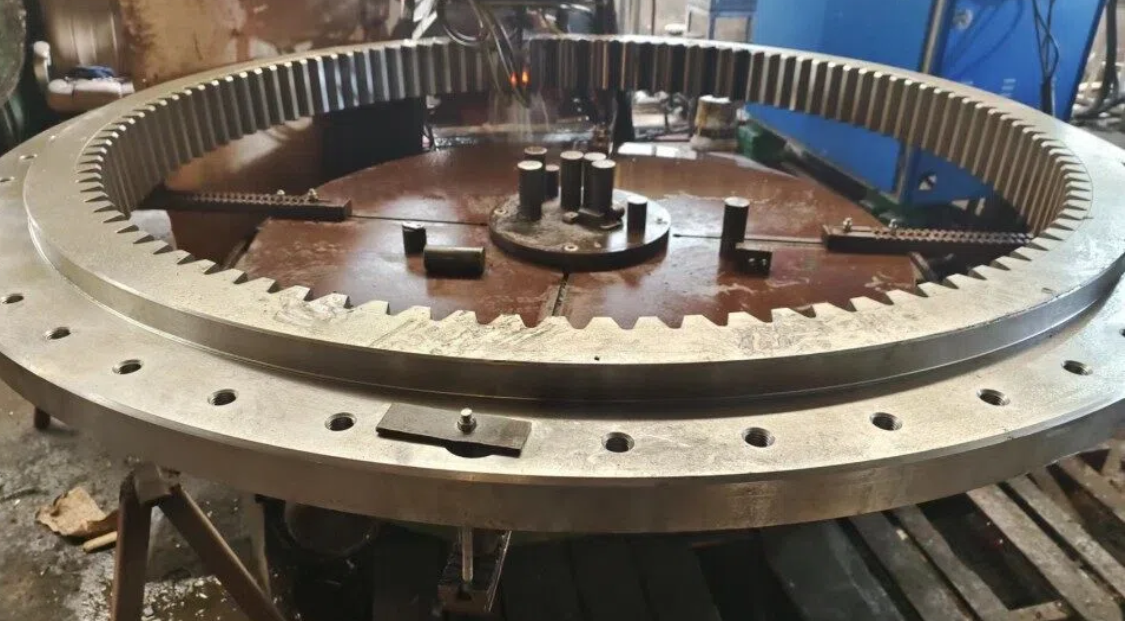
A slewing bearing, often called a turntable bearing or slewing ring, is a large-scale rolling-element bearing capable of supporting heavy axial and radial loads while enabling rotational movement. Unlike conventional bearings, slewing bearings have a much larger diameter relative to their cross-section and typically include mounting holes, internal or external gears, and sealing systems. Think of them as the "joint" that allows heavy machinery to rotate smoothly under massive loads.
How Does a Slewing Bearing Work?
A slewing bearing works by distributing loads through rolling elements (balls or rollers) arranged between two concentric rings — an inner ring and an outer ring. One ring typically rotates while the other remains stationary. The rolling elements run in hardened raceways, and the bearing can handle combined loads: axial force (vertical load), radial force (horizontal load), and tilting moment (overturning force). The integrated gear teeth on one ring allow a drive pinion to transmit torque, enabling precise rotation control in applications like cranes or solar trackers.
Main Types of Slewing Bearings
Understanding the inspection standards begins with knowing the different configurations. The most common types include:
Single-row four-point contact ball slewing bearings: These are the most widely used, ideal for applications requiring moderate load capacities and compact design. They can handle all three load types simultaneously.
Double-row ball slewing bearings: Featuring two independent rows of balls — one for axial loads and one for radial loads — these offer higher load capacity and are common in tower cranes.
Crossed roller slewing bearings: Using cylindrical rollers arranged in a crossed pattern, they provide high rotational accuracy and rigidity, making them suitable for precision machinery and robots.
Three-row roller slewing bearings: With separate raceways for axial, radial, and moment loads, these are designed for the heaviest applications, such as large excavators and offshore equipment.
Light and heavy-duty series: Variations in raceway geometry, gear options, and sealing arrangements further expand the selection.
Applications of Slewing Bearings
You will find slewing bearings wherever large-scale rotation is required. Common applications include:
Construction machinery: Truck cranes, excavators, concrete pumps, and tower cranes.
Renewable energy: Wind turbines (yaw and pitch bearings) and solar tracking systems.
Material handling: Stacker reclaimers, port cranes, and rotary feeders.
Aerial work platforms: Manlifts and cherry pickers.
Medical and industrial equipment: Large-diameter rotating tables and robotic turntables.
Each application demands specific performance levels, and that is precisely why inspection standards must be tailored and rigorous.
Slewing Bearing Inspection Standards
A complete inspection of a slewing bearing goes beyond a simple visual check. Based on our years of manufacturing experience, LyraDrive breaks down the verification process into eight critical areas. Each area addresses a specific performance aspect, and together they form a reliable quality assurance system.
Slewing Bearing Clearance Inspection
Clearance refers to the internal play between the rolling elements and raceways. During the design phase, engineers specify an optimal axial clearance (vertical movement) and radial clearance (horizontal movement) based on working loads and temperatures. After production, we measure these values using dial indicators or feeler gauges while rotating the bearing slowly.
If the clearance is too large, the bearing will have excessive tilting play, leading to impact loads and reduced positioning accuracy. If it is too small, friction increases, causing overheating and potential seizure. Only when both axial and radial clearance fall within the design tolerance range — typically between 0.05 mm and 0.3 mm for medium-sized bearings — is the bearing considered acceptable.
Slewing Bearing Runout Inspection
Runout measures how much the bearing deviates from true rotation. It is divided into axial runout (vertical wobble) and radial runout (horizontal eccentricity). To inspect runout, we mount the bearing on a precision fixture, rotate it 360 degrees, and record variations using a dial indicator placed against the reference surface.
Excessive axial runout causes uneven load distribution and premature wear on the gear teeth or mounting bolts. Excessive radial runout leads to vibration and noise in the driven mechanism. For most standard applications, axial runout should be within 0.10 mm, and radial runout within 0.15 mm. High-precision applications may require values as low as 0.02 mm.
Slewing Bearing Rotational Flexibility Inspection
This test simulates real operating conditions. Place the slewing bearing horizontally on a clean workbench. Under no load, rotate the inner ring relative to the outer ring by hand. A qualified bearing should turn smoothly with consistent, light resistance — typically requiring only a few newton meters of torque.
If rotation feels tight or sticky, apply a small amount of clean grease and rotate several times to distribute it. If stiffness remains, there may be raceway deformation or contamination. During rotation, listen carefully. A continuous, uniform rolling sound from the balls or rollers is normal. However, intermittent clicking, grinding, or sharp metallic noises indicates possible surface defects, debris inside, or damaged rolling elements. In such cases, stop immediately and contact the manufacturer for analysis.
Slewing Bearing Dimension Inspection
Every slewing bearing must match the design drawing exactly. Using calibrated measuring tools such as large calipers, micrometers, and CMM (coordinate measuring machine), we verify:
Inner diameter and outer diameter: Checked at multiple circumferential points to detect ovality.
Total thickness (height): Measured at four quadrants to ensure parallelism between mounting faces.
Mounting hole dimensions: Hole diameter, countersink depth, and pitch circle diameter must be accurate; otherwise, bolt alignment fails.
Gear dimensions (if applicable): Tooth height, pitch, and root diameter.
Any deviation beyond the specified tolerance — even 0.1 mm on a large bearing — can cause mounting difficulties or uneven load distribution.
Product Number and Label Inspection
Traceability is essential for quality control. After passing all functional tests, each slewing bearing receives a permanent product number engraved on the non-machined surface of the outer or inner ring. In addition, a durable label is attached, showing:
Model number and manufacturer code
Production date and batch number
Key specifications (clearance class, gear module, seal type)
A quality certificate is also issued, listing all inspection results. This system allows users to trace production records years later, which is invaluable for warranty claims or replacement orders.
Seal Installation Inspection
The seal is the first line of defense against contamination. A poorly installed seal allows sand, water, cement dust, or metal chips to enter the raceway, quickly destroying the rolling surfaces. During inspection, we rotate the bearing and visually check the entire circumference of the seal lip. The seal must lie flat against the sealing surface without gaps, twists, or exposed adhesive.
We also verify that the adhesive joints where the seal strip ends meet are bonded securely — no lifting or peeling. For bearings operating in harsh environments (e.g., excavators or mining equipment), we recommend an additional air blow test: low-pressure air is applied behind the seal to check for leakage paths.
Appearance Quality Inspection
While appearance does not directly affect bearing function, it strongly indicates a manufacturer's process discipline and quality culture. We examine the bearing under good lighting, looking for:
Machined surfaces: Smooth, uniform tool marks without chatter or gouges.
Mounting hole chamfers: Clean, free of burrs that could affect bolt seating.
Paint coating (if applied): Even coverage, no peeling, bubbles, or missing areas on non-machined surfaces.
Gear teeth: No visible cracks, nicks, or grinding burns.
A bearing with a rough appearance often signals shortcuts in production — and that usually correlates with hidden internal defects. Conversely, a clean, well-finished bearing reflects consistent process control.
Packaging Inspection
Proper packaging ensures the bearing arrives at your facility in the same condition as when it left our factory. The standard procedure at LyraDrive is:
Anti-rust oil coating: The entire bearing (except gear teeth if specified) is sprayed or dipped in high-quality rust preventive oil.
First layer – waterproof membrane: Wrapped tightly to block moisture.
Second layer – industrial stretch film: Provides mechanical protection and holds the membrane in place.
Third layer – additional waterproof membrane: For overseas shipments or high-humidity storage.
For bearings with special transport requirements — such as oversized dimensions, fragile seals, or long sea freight — we use custom wooden crates with internal foam padding and moisture-absorbing desiccants. Before sealing, we check that all labels are visible and that no packaging material contacts the seal lips directly.
Conclusion
Understanding slewing bearing inspection standards does not require you to become a bearing engineer overnight. By focusing on the eight key areas — clearance, runout, rotational flexibility, dimensions, labeling, seals, appearance, and packaging — you can confidently assess the quality of any slewing bearing. Remember, a well-inspected bearing not only prevents costly downtime but also ensures the safety of equipment and personnel. Always source from manufacturers who are transparent about their inspection processes and willing to share detailed test data.
LyraDrive: Get Your Slewing Bearing 3D Drawings for Your Application
Luoyang Slewing Bearing Co., Ltd. (LyraDrive) is a professional one-stop slewing device manufacturer majored in design and development, customized production, sales and service on slew drives and slewing bearings. LyraDrive provides high quality and customized slew bearings, slew drives and gear rings for truck cranes, excavators, manlifts, and other applications.
If you are looking for a reliable slewing drive supplier or need technical support, feel free to contact LyraDrive. We are ready to provide you with accurate 3D drawings based on your application requirements — whether you need a standard slewing ring or a fully customized slew drive. Let us help you get the right component, inspected to the highest standards, right from the start.
 WhatsApp
 sales@lyradrive.com
 +8613903880726